cdviz-collector
| Crates.io | cdviz-collector |
| lib.rs | cdviz-collector |
| version | 0.19.8 |
| created_at | 2024-12-12 14:58:06.8669+00 |
| updated_at | 2025-12-21 19:36:39.021054+00 |
| description | A service and CLI tool for collecting SDLC/CI/CD events and dispatching them as CDEvents |
| homepage | https://cdviz.dev |
| repository | https://github.com/cdviz-dev/cdviz-collector |
| max_upload_size | |
| id | 1481322 |
| size | 2,128,736 |
 David Bernard (davidB)
documentation
README

cdviz-collector



keywords: cdevents, sdlc, cicd
A service & CLI to collect SDLC/CI/CD events and dispatch as CDEvents.
Features
- Multiple event sources (
HTTPwebhooks, File system,S3,Kafka,SSE) - Multiple destinations (
PostgreSQL,HTTP, File system,Kafka,SSE) - Event transformation via
VRL(Vector Remap Language) - Three operation modes: server, one-shot sending, batch transformation
For comprehensive feature documentation, see cdviz.dev/docs/cdviz-collector.
Installation
cdviz-collector is distributed as:
- Pre-built binaries for Linux and macOS (GitHub Releases)
- Docker image at
ghcr.io/cdviz-dev/cdviz-collector - Helm chart for Kubernetes deployments
- Cargo package on crates.io
See the Installation Guide for detailed instructions.
Getting Started
See the Quick Start Guide for a 5-minute walkthrough.
Architecture
cdviz-collector uses a pipeline architecture: events flow from sources through an in-memory queue to multiple sinks.
---
config:
  theme: 'base'
  look: 'handDrawn'
  themeVariables:
    darkMode: true
    mainBkg: '#00000000'
    background: '#00000000'
    primaryColor: '#00000000'
    primaryTextColor: '#f08c00'
    secondaryTextColor: '#f08c00'
    tertiaryTextColor: '#f08c00'
    primaryBorderColor: '#f08c00'
    secondaryBorderColor: '#f08c00'
    tertiaryBorderColor: '#f08c00'
    noteTextColor: '#f08c00'
    noteBorderColor: '#f08c00'
    lineColor: '#f08c00'
    lineWidth: 2
---
flowchart LR
  classDef future stroke-dasharray: 5 5

  q>in memory queue of cdevents]

  subgraph sources
    src_cli(cli/stdin)
    src_http(HTTP)
    src_fs_content(FS folder with cdevents)
    src_fs_activity(FS folder activity)
    src_s3_content(S3 with cdevents)
    src_s3_activity(S3 activity)
    src_kafka(Kafka)
    src_nats(NATS):::future
    src_ecr(AWS ECR):::future
    src_misc(...):::future
  end
  src_cli --> q
  src_http --> q
  src_fs_content --> q
  src_fs_activity --> q
  src_s3_content --> q
  src_s3_activity --> q
  src_kafka --> q
  src_nats --> q
  src_ecr --> q
  src_misc --> q

  subgraph sinks
    sink_stdout(stdout)
    sink_db(DB)
    sink_http(HTTP)
    sink_kafka(Kafka)
    sink_nats(NATS):::future
  end
  q --> sink_stdout
  q --> sink_http
  q --> sink_db
  q --> sink_kafka
  q --> sink_nats
For detailed architecture information, see CLAUDE.md.
Configuration
Configure cdviz-collector via TOML files with environment variable overrides:
- Example config: examples/assets/cdviz-collector.toml
- Base config: src/assets/cdviz-collector.base.toml
- Environment variables:
CDVIZ_COLLECTOR__SECTION__KEY__VALUE
See the Configuration Guide and Use Cases & Examples for detailed information.
Usage
cdviz-collector provides three commands:
connect - Run as a Service
Launch collector as a long-running server to connect sources to sinks.
cdviz-collector connect --config cdviz-collector.toml
See the connect documentation for detailed options.
send - Send Events Directly
Send JSON data directly to a sink for testing and scripting.
cdviz-collector send --url https://api.example.com/webhook --data '{"test": "value"}'
See the send documentation for detailed options.
transform - Batch File Transformation
Transform local JSON files using configured transformers.
cdviz-collector transform --input ./input --output ./output --transformer-refs github_events
See the transform documentation for detailed options.
For all available options, use --help with any command or see the usage documentation.
GitHub Action
Send CDEvents from GitHub Actions workflows using cdviz-dev/send-cdevents.
Development
This project uses mise for task management:
mise install          # Setup environment
mise run build        # Build project
mise run test         # Run tests
mise run lint         # Run linting
mise run ci           # Full CI pipeline
See CONTRIBUTING.md for detailed development guidelines.
For AI assistance context, see CLAUDE.md.
License
This software is distributed under Apache Software License 2.0 ASL-2.0. You can subscribe to commercial support at http://cdviz.dev.
By using this software, you agree to comply with the terms of one of the above licenses.
For exceptions, see LICENSING.md.
Scripts, Transformer's template and Licensing
- Built-in scripts (included in this repository) are licensed under Apache Software License 2.0 ASL-2.0.
- User-provided scripts (loaded at runtime) are not subject to ASL-2.0 and can be under any license.
Contributing
We welcome contributions! Please see our Contributing Guide for more details.
By contributing to this project, you agree to the Contributor License Agreement (CLA).
Note: This project has been developed with assistance from Claude Code. All AI-generated code has been carefully reviewed, tested, and validated to ensure quality, security, and adherence to Rust best practices.
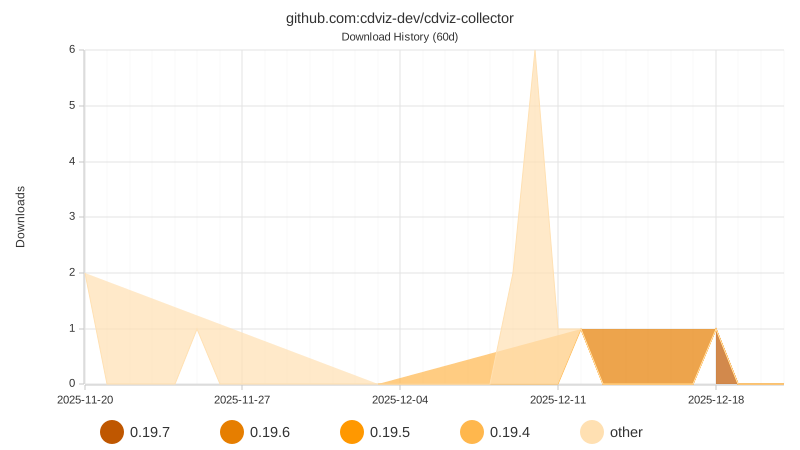
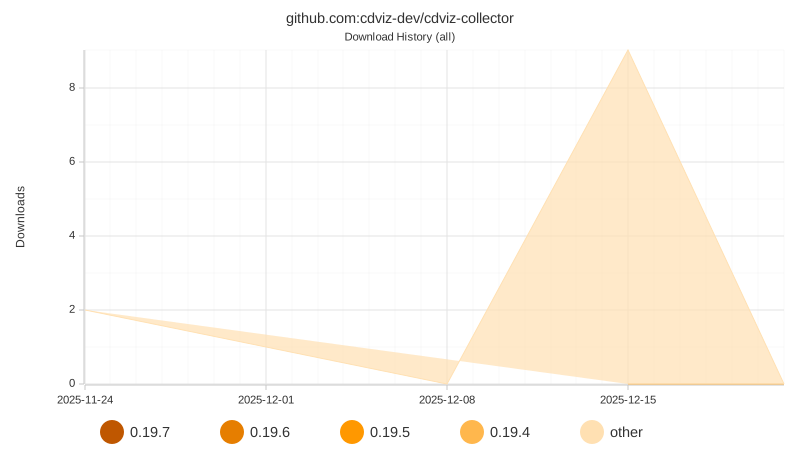
Downloads