itransformer
| Crates.io | itransformer |
| lib.rs | itransformer |
| version | 2.0.0 |
| created_at | 2025-01-03 23:15:15.621462+00 |
| updated_at | 2026-01-10 15:31:38.996707+00 |
| description | A Rust library for the iTransformer models. |
| homepage | https://github.com/rust-dd/iTransformer |
| repository | https://github.com/rust-dd/iTransformer |
| max_upload_size | |
| id | 1503124 |
| size | 99,315 |
 Daniel Boros (dancixx)
documentation
README



iTransformer: Rust Implementation
An iTransformer implementation in Rust using Hugging Face Candle, inspired by the lucidrains iTransformer repository, and based on the original research and implementation from Tsinghua University's iTransformer repository.
📚 What is iTransformer?
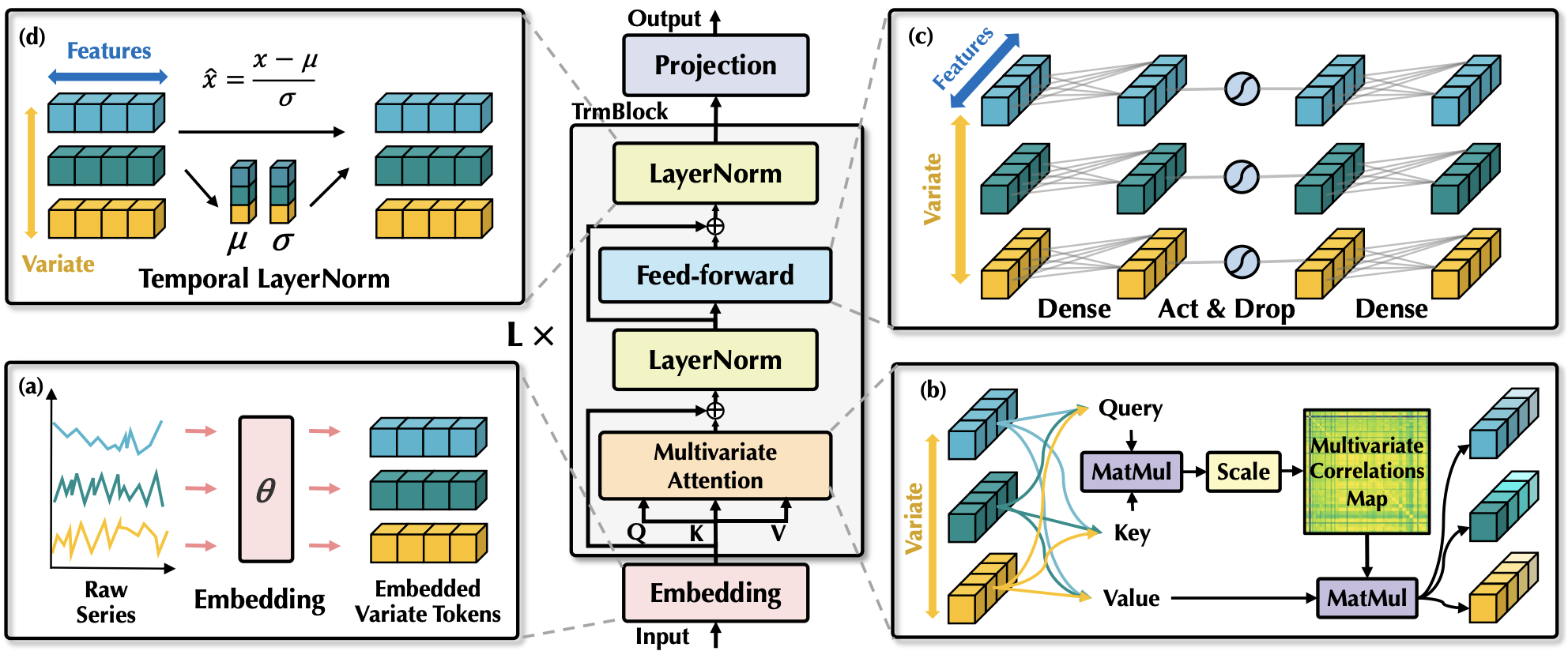
iTransformer introduces an inverted Transformer architecture designed for multivariate time series forecasting (MTSF). By reversing the conventional structure of Transformers, iTransformer achieves state-of-the-art results in handling complex multivariate time series data.
🚀 Key Features:
- Inverted Transformer Architecture: Captures multivariate correlations efficiently.
- Layer Normalization & Feed-Forward Networks: Optimized for time series representation.
- Flexible Prediction Lengths: Supports predictions at multiple horizons (e.g., 12, 24, 36, 48 steps ahead).
- Scalability: Handles hundreds of variates with efficiency.
- Zero-Shot Generalization: Train on partial variates and generalize to unseen variates.
- Multiple Model Variants: ITransformer, ITransformer2D, and ITransformerFFT.
- Hardware Acceleration: Metal (macOS) and CUDA support via Candle.
🛠️ Architecture Overview
iTransformer treats each time series variate as a token, applying attention mechanisms across variates, followed by feed-forward networks and normalization layers.
📊 Key Benefits:
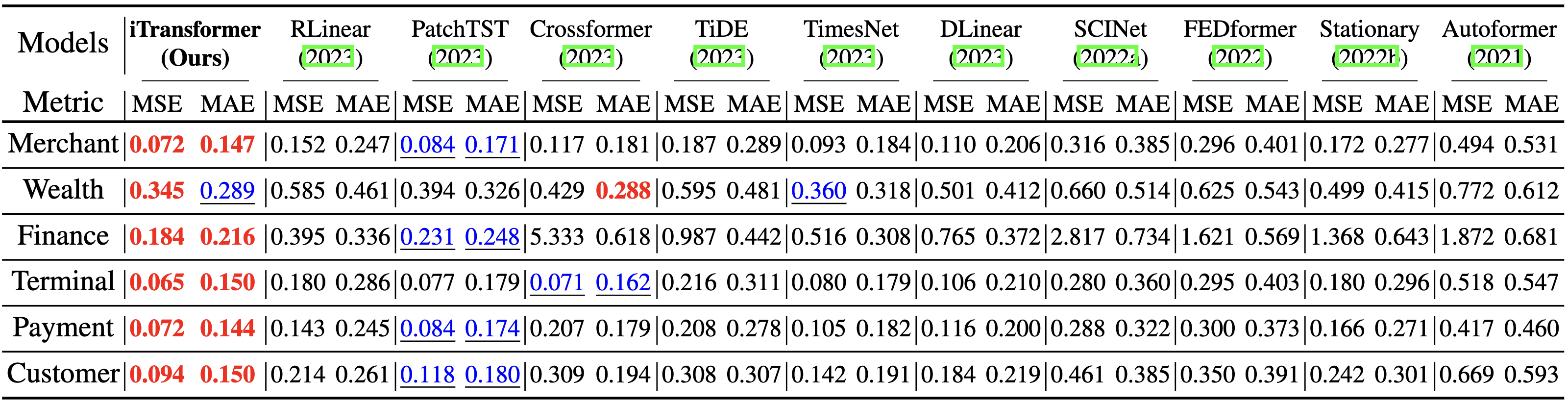
- State-of-the-Art Performance: On benchmarks such as Traffic, Weather, and Electricity datasets.
- Improved Interpretability: Multivariate self-attention reveals meaningful correlations.
- Scalable and Efficient Training: Can accommodate long time series without performance degradation.
📈 Performance Highlights:
iTransformer consistently outperforms other Transformer-based architectures in multivariate time series forecasting benchmarks.
📥 Installation
To get started, ensure you have Rust and Cargo installed. Then:
# Add iTransformer to your project dependencies
cargo add itransformer
For GPU acceleration:
# macOS Metal support
cargo add itransformer --features metal

# CUDA support
cargo add itransformer --features cuda
🏗️ Model Variants
This library provides three model variants:
| Model | Description |
|---|---|
ITransformer |
Base inverted transformer for multivariate time series forecasting |
ITransformer2D |
Extended variant with granular time attention via num_time_tokens parameter |
ITransformerFFT |
Variant with additional Fourier tokens prepended to the attention sequence |
📝 Usage
ITransformer (Base Model)
use candle_core::{Device, DType, Tensor};
use candle_nn::{VarBuilder, VarMap};
use itransformer::ITransformer;

fn main() -> candle_core::Result<()> {
    let device = Device::Cpu;
    let varmap = VarMap::new();
    let vb = VarBuilder::from_varmap(&varmap, DType::F32, &device);

    let model = ITransformer::new(
        vb,
        137,                      // num_variates
        96,                       // lookback_len
        6,                        // depth
        256,                      // dim
        Some(1),                  // num_tokens_per_variate
        vec![12, 24, 36, 48],     // pred_length
        Some(64),                 // dim_head
        Some(8),                  // heads
        None,                     // attn_drop_p
        None,                     // ff_mult
        None,                     // ff_drop_p
        None,                     // num_mem_tokens
        Some(true),               // use_reversible_instance_norm
        None,                     // reversible_instance_norm_affine
        false,                    // flash_attn
        &device,
    )?;

    let time_series = Tensor::randn(0f32, 1f32, (2, 96, 137), &device)?;
    let preds = model.forward(&time_series, None, false)?;
    println!("{:?}", preds);
    Ok(())
}
ITransformer2D (Time Token Variant)
use candle_core::{Device, DType, Tensor};
use candle_nn::{VarBuilder, VarMap};
use itransformer::ITransformer2D;

fn main() -> candle_core::Result<()> {
    let device = Device::Cpu;
    let varmap = VarMap::new();
    let vb = VarBuilder::from_varmap(&varmap, DType::F32, &device);

    let model = ITransformer2D::new(
        vb,
        137,                      // num_variates
        96,                       // lookback_len
        4,                        // depth
        256,                      // dim
        8,                        // num_time_tokens (lookback_len must be divisible by this)
        vec![12, 24],             // pred_length
        Some(32),                 // dim_head
        Some(4),                  // heads
        None, None, None, None, None, None,
        false,                    // flash_attn
        &device,
    )?;

    let time_series = Tensor::randn(0f32, 1f32, (2, 96, 137), &device)?;
    let preds = model.forward(&time_series, None, false)?;
    println!("{:?}", preds);
    Ok(())
}
ITransformerFFT (Fourier Token Variant)
use candle_core::{Device, DType, Tensor};
use candle_nn::{VarBuilder, VarMap};
use itransformer::ITransformerFFT;

fn main() -> candle_core::Result<()> {
    let device = Device::Cpu;
    let varmap = VarMap::new();
    let vb = VarBuilder::from_varmap(&varmap, DType::F32, &device);

    let model = ITransformerFFT::new(
        vb,
        137,                      // num_variates
        96,                       // lookback_len
        4,                        // depth
        256,                      // dim
        Some(1),                  // num_tokens_per_variate
        4,                        // num_fft_tokens
        vec![12, 24],             // pred_length
        Some(32),                 // dim_head
        Some(4),                  // heads
        None, None, None, None, None, None,
        false,                    // flash_attn
        &device,
    )?;

    let time_series = Tensor::randn(0f32, 1f32, (2, 96, 137), &device)?;
    let preds = model.forward(&time_series, None, false)?;
    println!("{:?}", preds);
    Ok(())
}
📁 Project Structure
src/
├── attend.rs           # Attention computation
├── attention.rs        # ToQKV, ToValueResidualMix, ToVGates, ToOut, Attention
├── feedforward.rs      # GEGLU, FeedForward
├── itransformer.rs     # Base ITransformer
├── itransformer2d.rs   # ITransformer2D with time tokens
├── itransformer_fft.rs # ITransformerFFT with Fourier tokens
├── lib.rs              # Module declarations and re-exports
├── mlp_in.rs           # Input projection layer
├── pred_head.rs        # Prediction heads
├── revin.rs            # Reversible Instance Normalization
📖 References
- Paper: iTransformer: Inverted Transformers Are Effective for Time Series Forecasting
- Original Implementation: thuml/iTransformer
- Inspired by: lucidrains/iTransformer
🏆 Acknowledgments
This work draws inspiration and insights from the following projects:
Special thanks to the contributors and researchers behind iTransformer for their pioneering work.
📑 Citation
@article{liu2023itransformer,
  title={iTransformer: Inverted Transformers Are Effective for Time Series Forecasting},
  author={Liu, Yong and Hu, Tengge and Zhang, Haoran and Wu, Haixu and Wang, Shiyu and Ma, Lintao and Long, Mingsheng},
  journal={arXiv preprint arXiv:2310.06625},
  year={2023}
}
🌟 Contributing
Contributions are welcome! Please follow the standard GitHub pull request process and ensure your code adheres to Rust best practices.
This repository is a Rust adaptation of the cutting-edge iTransformer model, aiming to bring efficient and scalable time series forecasting capabilities to the Rust ecosystem.