lazy-prime-sieve
| Crates.io | lazy-prime-sieve |
| lib.rs | lazy-prime-sieve |
| version | 0.1.3 |
| created_at | 2023-07-11 18:33:58.460575+00 |
| updated_at | 2023-07-16 04:35:44.845035+00 |
| description | Lazy Sieve of Eratosthenes for infinitely generating primes lazily in Rust. |
| homepage | |
| repository | https://github.com/arindas/lazy-prime-sieve |
| max_upload_size | |
| id | 914052 |
| size | 21,193 |
 Arindam Das (arindas)
documentation
README
lazy-prime-sieve




Lazy Sieve of Eratosthenes for infinitely generating primes lazily in Rust.
Usage
lazy-prime-sieve is a library crate. You may add it to your Cargo.toml as
follows:
[dependencies]
lazy-prime-sieve = "0.1.3"
lazy-prime-sieve provides iterators for infinitely generating primes. This
crate provides a convenience method ::primes() which returns the most
efficient iterator (in this crate) for generating primes.
use lazy_prime_sieve::primes;

for i in primes().take(10) {
    println!("{i}");
}
Design
This crate provides two types of abstractions: sieve(s) and source(s).
source(s) represent infinite sources of integers from which we sample primes.sieve(s) sample primes fromsource(s).
Both source(s) and sieve(s) implement Iterator<Item = u64>.
This crate provides the following sieves:
UnfaithfulSieve: Non-recursiveIteratorbased alternative to classic Haskell lazy recursive prime sieve:primes = sieve [2..] sieve (p : xs) = p : sieve [x | x <− xs, x ‘mod‘ p > 0]TrialDivsionSieve: The modulus-based memoized approach of generating primes that we all know and love.GenuineSieve: Priority Queue based solution, true to the original Sieve of Eratosthenes algorithm.
This crate provides the following sources:
integer_candidates(): Returns an iterator which yields the sequence 2, 3, 4, 5, 6, 7, …odds_with_2(): Returns an iterator which yields the sequence 2, 3, 5, 7, 9, …SpinWheel::default(): Iterator of monotonically increasing integers which are not multiples of 2, 3, 5 and 7.
Mostly, we initialize a sieve with a source and start generating primes:
use lazy_prime_sieve::{sieve::TrialDivisionSieve, source::odds_with_2};

// print the first 10 primes
TrialDivisionSieve::with_source(odds_with_2())
  .take(10)
  .for_each(|x| println!("{x}"));
However, some sources start from a high number. So we need to chain the initial primes:
use lazy_prime_sieve::{source::SpinWheel, sieve::GenuineSieve};

// starts from 11
let source = SpinWheel::default();

// print the first 10 primes
[2, 3, 5, 7]
    .iter()
    .cloned()
    .chain(GenuineSieve::with_source(source))
    .take(10)
    .for_each(|x| println!("{x}"));
Refer to the documentation for further details.
Benchmarks
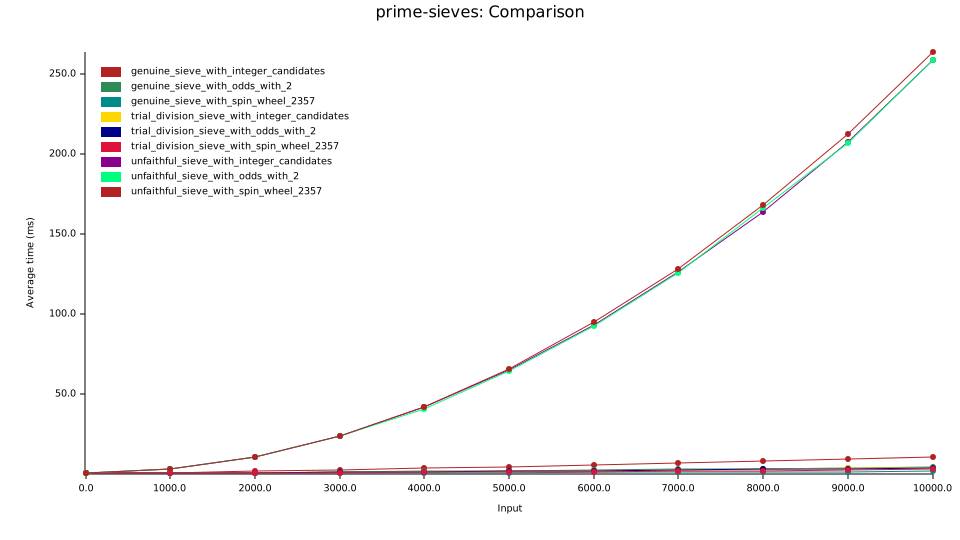
This benchmark shows the time taken by the different (source, sieve)
combinations (fmt: "{sieve}_with_{source}") in this crate to generate a
certain number of primes. The x-axis shows the number of primes generated,
while the y-axis shows the time taken.
The fastest combination is GenuineSieve with SpinWheel::default(). This is
the combination used by lazy_prime_sieve::primes().
See the generated benchmark report here.
These benchmarks were run on an AMD Ryzen 7 x86_64 machine in WSL with 8 GB RAM allocated to WSL.
References
This crate heavily draws from the paper The Genuine Sieve of Eratosthenes. This repository attempts to provide non-recursive lazy Rust iterator based alternatives to the Haskell lazy list + recursion based methods proposed in the paper.
License
lazy-prime-sieve is licensed under the MIT License. See
License
for more details.