missive
| Crates.io | missive |
| lib.rs | missive |
| version | 0.6.2 |
| created_at | 2026-01-08 05:13:55.748266+00 |
| updated_at | 2026-01-19 21:11:06.257292+00 |
| description | Compose, deliver, preview, and test emails in Rust - pluggable providers with zero configuration code |
| homepage | |
| repository | https://github.com/jeffhuen/missive |
| max_upload_size | |
| id | 2029584 |
| size | 858,417 |
 (jeffhuen)
documentation
README
Missive
Compose, deliver, test, and preview emails in Rust. Plug and play.
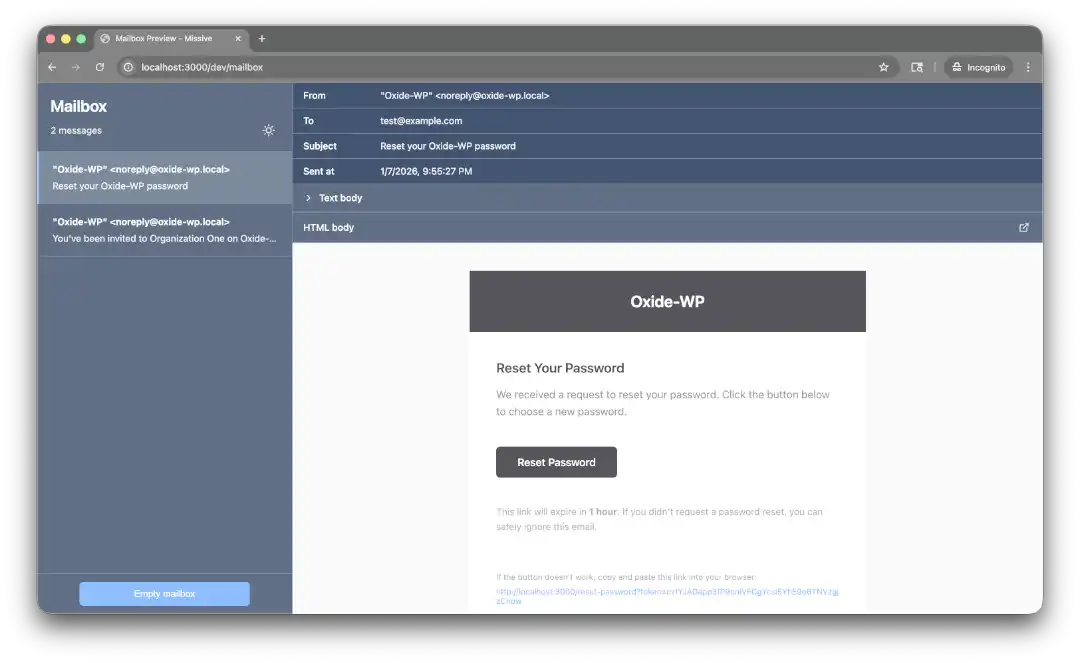
Missive comes with adapters for popular transactional email providers including Amazon SES, Gmail, JMAP, Mailgun, Resend, SendGrid, Postmark, Proton Bridge, SocketLabs, SMTP, and more. For local development, it includes an in-memory mailbox with a web-based preview UI, plus a logger provider for debugging. No initialization code required for most setups.
Requirements
Rust 1.75+ (async traits)
Quick Start
Add to your .env:
# ---- Missive Email ----
EMAIL_PROVIDER=resend
EMAIL_FROM=noreply@example.com
RESEND_API_KEY=re_xxxxx
Send emails:
use missive::{Email, deliver};

let email = Email::new()
    .to("user@example.com")
    .subject("Welcome!")
    .text_body("Thanks for signing up.");

deliver(&email).await?;
That's it. No configuration code, no builder structs, no initialization.
Installation
Add missive to your Cargo.toml:
[dependencies]
missive = { version = "0.6.0", features = ["resend"] }
Enable the feature for your email provider. See Feature Flags for all options.
Providers
Missive supports popular transactional email services out of the box:
| Provider | Feature | Environment Variables |
|---|---|---|
| SMTP | smtp |
SMTP_HOST, SMTP_PORT, SMTP_USERNAME, SMTP_PASSWORD |
| Resend | resend |
RESEND_API_KEY |
| SendGrid | sendgrid |
SENDGRID_API_KEY |
| Postmark | postmark |
POSTMARK_API_KEY |
| Brevo | brevo |
BREVO_API_KEY |
| Mailgun | mailgun |
MAILGUN_API_KEY, MAILGUN_DOMAIN |
| Mailjet | mailjet |
MAILJET_API_KEY, MAILJET_SECRET_KEY |
| Amazon SES | amazon_ses |
AWS_REGION, AWS_ACCESS_KEY_ID, AWS_SECRET_ACCESS_KEY |
| Mailtrap | mailtrap |
MAILTRAP_API_KEY |
| SocketLabs | socketlabs |
SOCKETLABS_SERVER_ID, SOCKETLABS_API_KEY |
| Gmail | gmail |
GMAIL_ACCESS_TOKEN |
| JMAP | jmap |
JMAP_URLJMAP_USERNAMEJMAP_PASSWORD |
| Proton Bridge | protonbridge |
PROTONBRIDGE_USERNAMEPROTONBRIDGE_PASSWORD |
| Unsent | unsent |
UNSENT_API_KEY |
| Local | local |
(none) |
| Logger | (always available) | (none) |
Configure which provider to use with the EMAIL_PROVIDER environment variable:
EMAIL_PROVIDER=sendgrid
Feature Flags
Missive uses Cargo features for conditional compilation - only the providers you enable are compiled into your binary. This keeps binaries small and compile times fast.
Minimal: Single Provider
If you only use one provider, enable just that feature:
[dependencies]
missive = { version = "0.6.0", features = ["resend"] }
RESEND_API_KEY=re_xxxxx
# EMAIL_PROVIDER is auto-detected when only one is enabled
This gives you the smallest binary and fastest compile. You'd need to recompile to switch providers.
Flexible: Multiple Providers
For runtime flexibility (e.g., different providers per environment), enable multiple:
[dependencies]
missive = { version = "0.6.0", features = ["smtp", "resend", "local"] }
Then configure per environment in .env:
# ---- Missive Email ----
# Development: local mailbox preview at /dev/mailbox
EMAIL_PROVIDER=local
EMAIL_FROM=noreply@example.com
# ---- Missive Email ----
# Staging: test with Resend
EMAIL_PROVIDER=resend
EMAIL_FROM=noreply@example.com
RESEND_API_KEY=re_test_xxx
# ---- Missive Email ----
# Production: your own SMTP
EMAIL_PROVIDER=smtp
EMAIL_FROM=noreply@example.com
SMTP_HOST=mail.example.com
SMTP_USERNAME=apikey
SMTP_PASSWORD=your-api-key
Same compiled binary, different behavior per environment.
Auto-Detection
When EMAIL_PROVIDER is not set, Missive automatically detects which provider to use based on:
- Available API keys - checks for
RESEND_API_KEY,SENDGRID_API_KEY, etc. - Enabled features - only considers providers whose feature is compiled in
- Fallback to local - if the
localfeature is enabled and no API keys found
Detection order: Resend → SendGrid → Postmark → Unsent → SMTP → Local
This means zero-config for simple setups:
missive = { version = "0.6.0", features = ["resend"] }
RESEND_API_KEY=re_xxxxx
# No EMAIL_PROVIDER needed - Resend is auto-detected
Use EMAIL_PROVIDER explicitly when:
- Multiple providers are enabled and you want to choose one
- You want to override auto-detection
- You're using
loggerorlogger_full(no API key to detect)
Bundles
# Development setup (local + preview UI)
missive = { version = "0.6.0", features = ["dev"] }

# Everything (all providers + templates)
missive = { version = "0.6.0", features = ["full"] }
Available Features
| Feature | Description |
|---|---|
smtp |
SMTP provider via lettre |
resend |
Resend API |
sendgrid |
SendGrid API |
postmark |
Postmark API |
brevo |
Brevo API (formerly Sendinblue) |
mailgun |
Mailgun API |
mailjet |
Mailjet API |
amazon_ses |
Amazon SES API |
mailtrap |
Mailtrap API |
socketlabs |
SocketLabs Injection API |
gmail |
Gmail API (OAuth2) |
jmap |
JMAP (RFC 8621) - works with Stalwart, Fastmail, Cyrus, etc. |
protonbridge |
Proton Mail via local Bridge |
unsent |
Unsent API |
local |
LocalMailer - in-memory storage + test assertions |
preview |
Standalone preview server (tiny_http) |
preview-axum |
Preview UI embedded in Axum |
preview-actix |
Preview UI embedded in Actix |
templates |
Askama template integration |
metrics |
Prometheus-style metrics |
dev |
Enables local + preview |
full |
All providers + templates + preview |
Environment Variables
Global Settings
| Variable | Description | Default |
|---|---|---|
EMAIL_PROVIDER |
Which provider to use | smtp |
EMAIL_FROM |
Default sender email | (none) |
EMAIL_FROM_NAME |
Default sender name | (none) |
Provider-Specific
SMTP:
| Variable | Description | Default |
|---|---|---|
SMTP_HOST |
SMTP server hostname | (required) |
SMTP_PORT |
SMTP server port | 587 |
SMTP_USERNAME |
SMTP username | (optional) |
SMTP_PASSWORD |
SMTP password | (optional) |
SMTP_TLS |
TLS mode: required, opportunistic, none |
required |
API Providers:
| Variable | Provider |
|---|---|
RESEND_API_KEY |
Resend |
SENDGRID_API_KEY |
SendGrid |
POSTMARK_API_KEY |
Postmark |
UNSENT_API_KEY |
Unsent |
Composing Emails
Basic Email
use missive::Email;

let email = Email::new()
    .from("sender@example.com")
    .to("recipient@example.com")
    .subject("Hello!")
    .text_body("Plain text content")
    .html_body("<h1>HTML content</h1>");
With Display Names
let email = Email::new()
    .from(("Alice Smith", "alice@example.com"))
    .to(("Bob Jones", "bob@example.com"))
    .subject("Meeting tomorrow");
Multiple Recipients
let email = Email::new()
    .to("one@example.com")
    .to("two@example.com")
    .cc("cc@example.com")
    .bcc("bcc@example.com")
    .reply_to("replies@example.com");
Custom Headers
let email = Email::new()
    .header("X-Custom-Header", "custom-value")
    .header("X-Priority", "1");
Provider-Specific Options
Pass options specific to your email provider:
// Resend: tags and scheduling
let email = Email::new()
    .provider_option("tags", json!([{"name": "category", "value": "welcome"}]))
    .provider_option("scheduled_at", "2024-12-01T00:00:00Z");

// SendGrid: categories and tracking
let email = Email::new()
    .provider_option("categories", json!(["transactional", "welcome"]))
    .provider_option("tracking_settings", json!({"click_tracking": {"enable": true}}));
Custom Recipient Types
Implement ToAddress for your types to use them directly in email builders:
use missive::{Address, ToAddress, Email};

struct User {
    name: String,
    email: String,
}

impl ToAddress for User {
    fn to_address(&self) -> Address {
        Address::with_name(&self.name, &self.email)
    }
}

// Now use directly:
let user = User { name: "Alice".into(), email: "alice@example.com".into() };
let email = Email::new()
    .to(&user)
    .subject("Welcome!");
Email Validation
Missive provides email address validation:
use missive::Address;

// Lenient (logs warnings for suspicious input)
let addr = Address::new("user@example.com");

// Strict RFC 5321/5322 validation
let addr = Address::parse("user@example.com")?;
let addr = Address::parse_with_name("Alice", "alice@example.com")?;

// International domain names (IDN/Punycode)
let addr = Address::new("user@example.jp");
let ascii = addr.to_ascii()?;  // Converts to punycode if needed
Attachments
From Bytes
use missive::{Email, Attachment};

let email = Email::new()
    .to("user@example.com")
    .subject("Your report")
    .attachment(
        Attachment::from_bytes("report.pdf", pdf_bytes)
            .content_type("application/pdf")
    );
From File
// Eager loading (reads file immediately)
let attachment = Attachment::from_path("/path/to/file.pdf")?;

// Lazy loading (reads file at send time)
let attachment = Attachment::from_path_lazy("/path/to/large-file.zip")?;
Inline Attachments (HTML Embedding)
let email = Email::new()
    .html_body(r#"<img src="cid:logo">"#)
    .attachment(
        Attachment::from_bytes("logo.png", png_bytes)
            .inline()
            .content_id("logo")
    );
Testing
Use LocalMailer to capture emails in tests:
use missive::{Email, deliver_with, configure};
use missive::providers::LocalMailer;
use missive::testing::*;

#[tokio::test]
async fn test_welcome_email() {
    let mailer = LocalMailer::new();
    configure(mailer.clone());

    // Your code that sends an email
    send_welcome_email("user@example.com").await;

    // Assertions
    assert_email_sent(&mailer);
    assert_email_to(&mailer, "user@example.com");
    assert_email_subject_contains(&mailer, "Welcome");
    assert_email_count(&mailer, 1);
}
Available Assertions
| Function | Description |
|---|---|
assert_email_sent(&mailer) |
At least one email was sent |
assert_no_emails_sent(&mailer) |
No emails were sent |
assert_email_count(&mailer, n) |
Exactly n emails were sent |
assert_email_to(&mailer, email) |
Email was sent to address |
assert_email_from(&mailer, email) |
Email was sent from address |
assert_email_subject(&mailer, subject) |
Email has exact subject |
assert_email_subject_contains(&mailer, text) |
Subject contains text |
assert_email_html_contains(&mailer, text) |
HTML body contains text |
assert_email_text_contains(&mailer, text) |
Text body contains text |
refute_email_to(&mailer, email) |
No email was sent to address |
Simulating Failures
let mailer = LocalMailer::new();
mailer.set_failure("SMTP connection refused");

let result = deliver_with(&email, &mailer).await;
assert!(result.is_err());
Flush Emails
// Get and clear all emails atomically
let emails = flush_emails(&mailer);
assert_eq!(emails.len(), 3);

// Mailer is now empty
assert_no_emails_sent(&mailer);
Mailbox Preview
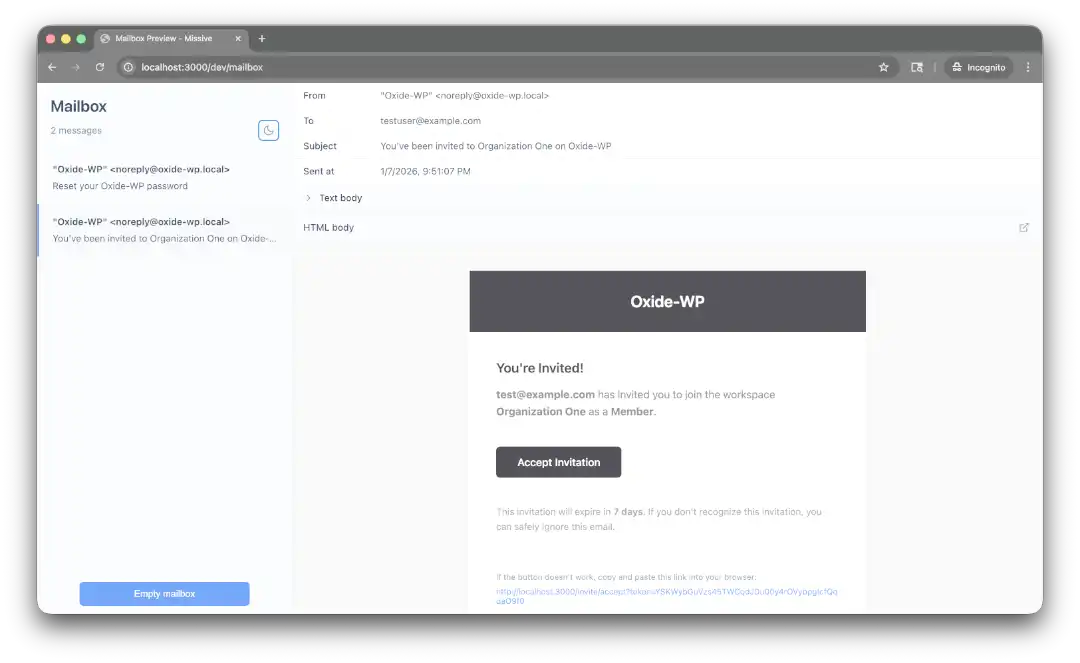
View sent emails in your browser during development.
Standalone Server (Recommended)
The simplest option - runs on a separate port with no framework dependencies:
use missive::preview::PreviewServer;

// Initialize mailer from environment variables
missive::init().ok();

// Start preview server if using local provider
if let Some(storage) = missive::local_storage() {
    PreviewServer::new("127.0.0.1:3025", storage)
        .expect("Failed to start preview server")
        .spawn();

    println!("Preview UI at http://127.0.0.1:3025");
}
Set in your .env:
EMAIL_PROVIDER=local
EMAIL_FROM=noreply@example.com
Axum Integration
Embed the preview UI into your Axum app:
use missive::preview::mailbox_router;

missive::init().ok();

let mut app = Router::new()
    .route("/", get(home));

if let Some(storage) = missive::local_storage() {
    // Use .nest_service() if your app has custom state (Router<AppState>)
    // Use .nest() if your app is Router<()>
    app = app.nest_service("/dev/mailbox", mailbox_router(storage));
}
Then visit http://localhost:3000/dev/mailbox. See docs/preview.md for more details.
Actix Integration
See docs/preview.md for Actix configuration.
Features
- View all sent emails
- HTML and plain text preview
- View email headers
- Download attachments
- Delete individual emails or clear all
- Dark mode toggle
- JSON API for programmatic access
Interceptors
Interceptors let you modify or block emails before they are sent. Use them to add headers, redirect recipients in development, or enforce business rules.
use missive::{Email, InterceptorExt};
use missive::providers::ResendMailer;

let mailer = ResendMailer::new(api_key)
    // Add tracking header to all emails
    .with_interceptor(|email: Email| {
        Ok(email.header("X-Request-ID", get_request_id()))
    })
    // Block emails to certain domains
    .with_interceptor(|email: Email| {
        for recipient in &email.to {
            if recipient.email.ends_with("@blocked.com") {
                return Err(MailError::SendError("Blocked domain".into()));
            }
        }
        Ok(email)
    });
See docs/interceptors.md for more examples including development redirects and multi-tenant branding.
Per-Call Mailer Override
Override the global mailer for specific emails:
use missive::{Email, deliver_with};
use missive::providers::ResendMailer;

// Use a different API key for this one email
let special_mailer = ResendMailer::new("different_api_key");

let email = Email::new()
    .to("vip@example.com")
    .subject("Special delivery");

deliver_with(&email, &special_mailer).await?;
Async Emails
Missive's deliver() is already async. For fire-and-forget sending:
// Using tokio::spawn
tokio::spawn(async move {
    if let Err(e) = deliver(&email).await {
        tracing::error!("Failed to send email: {}", e);
    }
});
For reliable delivery, use a job queue like apalis:
use apalis::prelude::*;

#[derive(Debug, Serialize, Deserialize)]
struct SendEmailJob {
    to: String,
    subject: String,
    body: String,
}

async fn send_email(job: SendEmailJob, _ctx: JobContext) -> Result<(), Error> {
    let email = Email::new()
        .to(&job.to)
        .subject(&job.subject)
        .text_body(&job.body);

    deliver(&email).await?;
    Ok(())
}
Metrics
Enable Prometheus-style metrics with features = ["metrics"]:
missive = { version = "0.6.0", features = ["resend", "metrics"] }
Missive emits these metrics:
| Metric | Type | Labels | Description |
|---|---|---|---|
missive_emails_total |
Counter | provider, status | Total emails sent |
missive_delivery_duration_seconds |
Histogram | provider | Delivery duration |
missive_batch_total |
Counter | provider, status | Batch operations |
missive_batch_size |
Histogram | provider | Emails per batch |
Install a recorder in your app to collect them:
// Using metrics-exporter-prometheus
metrics_exporter_prometheus::PrometheusBuilder::new()
    .install()
    .expect("failed to install Prometheus recorder");
If you don't install a recorder, metric calls are no-ops (zero overhead).
Observability
Missive uses the tracing crate for observability. All email deliveries create spans:
missive.deliver { provider="resend", to=["user@example.com"], subject="Hello" }
Configure with any tracing subscriber:
tracing_subscriber::fmt::init();
Error Handling
Delivery errors are returned to the caller - missive does not automatically retry or crash. Errors are logged via tracing::error! for observability.
match deliver(&email).await {
    Ok(result) => println!("Sent: {}", result.message_id),
    Err(e) => {
        // You decide: retry, alert, queue for later, ignore, etc.
        println!("Failed: {}", e);
    }
}
Error variants for granular handling:
use missive::{deliver, MailError};

match deliver(&email).await {
    Ok(result) => println!("Sent with ID: {}", result.message_id),
    Err(MailError::MissingField(field)) => println!("Missing: {}", field),
    Err(MailError::InvalidAddress(msg)) => println!("Bad address: {}", msg),
    Err(MailError::ProviderError { provider, message, .. }) => {
        println!("{} error: {}", provider, message);
    }
    Err(e) => println!("Error: {}", e),
}
Logger Provider
Use EMAIL_PROVIDER=logger to only log emails without sending:
# Brief logging (just recipients and subject)
EMAIL_PROVIDER=logger

# Full logging (all fields, bodies at debug level)
EMAIL_PROVIDER=logger_full
Useful for staging environments or debugging.
Templates
Enable features = ["templates"] for Askama integration:
use missive::{Email, EmailTemplate};
use askama::Template;

#[derive(Template)]
#[template(path = "welcome.html")]
struct WelcomeEmail {
    username: String,
    action_url: String,
}

let template = WelcomeEmail {
    username: "Alice".into(),
    action_url: "https://example.com/verify".into(),
};

let email = Email::new()
    .to("alice@example.com")
    .subject("Welcome!")
    .render_html(&template)?;
API Reference
Core Functions
| Function | Description |
|---|---|
deliver(&email) |
Send email using global mailer |
deliver_with(&email, &mailer) |
Send email using specific mailer |
deliver_many(&emails) |
Send multiple emails |
configure(mailer) |
Set the global mailer |
init() |
Initialize from environment variables |
is_configured() |
Check if email is properly configured |
Email Builder
| Method | Description |
|---|---|
.from(addr) |
Set sender |
.to(addr) |
Add recipient |
.cc(addr) |
Add CC recipient |
.bcc(addr) |
Add BCC recipient |
.reply_to(addr) |
Add reply-to address |
.subject(text) |
Set subject line |
.text_body(text) |
Set plain text body |
.html_body(html) |
Set HTML body |
.attachment(att) |
Add attachment |
.header(name, value) |
Add custom header |
.provider_option(key, value) |
Set provider-specific option |
.assign(key, value) |
Set template variable |
Documentation
For more detailed guides, see the docs/ folder:
- Interceptors - Modify or block emails before delivery
- Providers - Detailed configuration for each email provider
- Testing - Complete testing guide with all assertion functions
- Observability - Telemetry, metrics, Grafana dashboards, and alerting
- Preview - Mailbox preview UI configuration
- Templates - Askama template integration
Acknowledgments
Missive's design is inspired by Swoosh, the excellent Elixir email library.
License
MIT