rust_xlsxwriter_derive
| Crates.io | rust_xlsxwriter_derive |
| lib.rs | rust_xlsxwriter_derive |
| version | 0.2.0 |
| created_at | 2024-01-13 01:09:18.151921+00 |
| updated_at | 2024-01-23 23:36:14.001416+00 |
| description | Proc macros to support rust_xlsxwriter serialization |
| homepage | https://rustxlsxwriter.github.io |
| repository | https://github.com/jmcnamara/rust_xlsxwriter |
| max_upload_size | |
| id | 1098202 |
| size | 46,790 |
 John McNamara (jmcnamara)
documentation
README
rust_xlsxwriter_derive
The rust_xlsxwriter_derive crate provides the XlsxSerialize derived
trait which is used in conjunction with rust_xlsxwriter serialization.
XlsxSerialize can be used to set container and field attributes for structs to
define Excel formatting and other options when serializing them to Excel using
rust_xlsxwriter and Serde.
use rust_xlsxwriter::{Workbook, XlsxError, XlsxSerialize};
use serde::Serialize;

fn main() -> Result<(), XlsxError> {
    let mut workbook = Workbook::new();

    // Add a worksheet to the workbook.
    let worksheet = workbook.add_worksheet();

    // Create a serializable struct.
    #[derive(XlsxSerialize, Serialize)]
    #[xlsx(header_format = Format::new().set_bold())]
    struct Produce {
        #[xlsx(rename = "Item", column_width = 12.0)]
        fruit: &'static str,

        #[xlsx(rename = "Price", num_format = "$0.00")]
        cost: f64,
    }

    // Create some data instances.
    let items = [
        Produce {
            fruit: "Peach",
            cost: 1.05,
        },
        Produce {
            fruit: "Plum",
            cost: 0.15,
        },
        Produce {
            fruit: "Pear",
            cost: 0.75,
        },
    ];

    // Set the serialization location and headers.
    worksheet.set_serialize_headers::<Produce>(0, 0)?;

    // Serialize the data.
    worksheet.serialize(&items)?;

    // Save the file to disk.
    workbook.save("serialize.xlsx")?;

    Ok(())
}
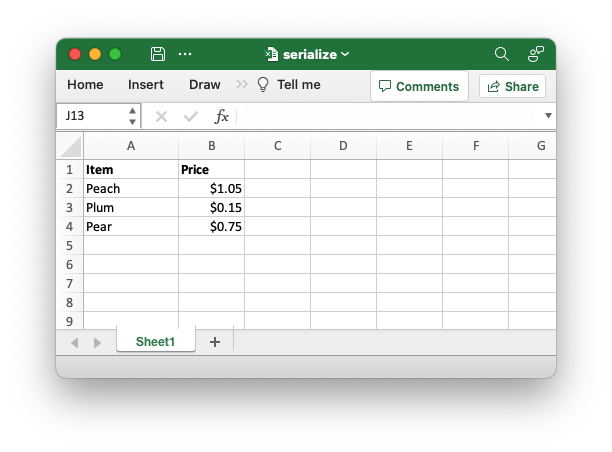
The output file is shown below. Note the change or column width in Column A, the renamed headers and the currency format in Column B numbers.
For more information see the documentation on Working with Serde in the
rust_xlsxwriter docs.