stroke
| Crates.io | stroke |
| lib.rs | stroke |
| version | 0.3.0 |
| created_at | 2021-02-22 20:49:15.284696+00 |
| updated_at | 2026-01-22 13:39:55.168517+00 |
| description | Zero-allocation, const-generic implementations of Bézier and B-Spline curves in N-dimensional euclidean space. |
| homepage | |
| repository | https://github.com/dorianprill/stroke |
| max_upload_size | |
| id | 359178 |
| size | 269,416 |
 (dorianprill)
documentation
README
stroke


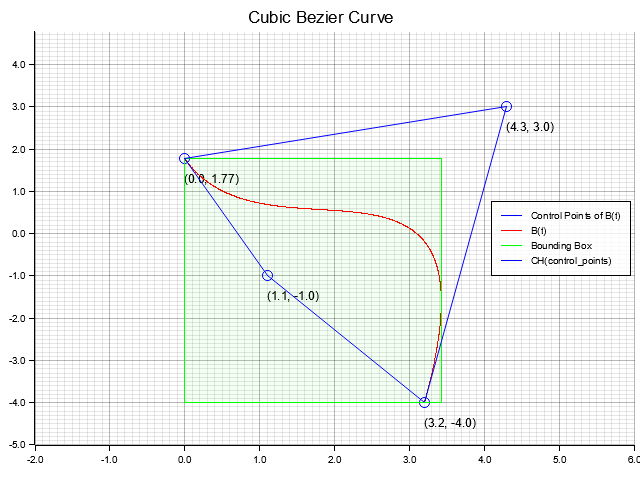
made with plotters.rs
A zero-allocation library providing const-generic implementations of Bézier curves, B-Spline curves and specialized implementations of up to cubic Bézier curves in N-dimensional euclidean space. It is intended for general/embedded/wasm use supporting #![no_std] environments written in 100% safe Rust with minimal dependencies.
The library makes heavy use of const-generics and generic_const_exprs, so the nightly compiler is required.
This repo uses nightly via rust-toolchain.
It comes with a const-generic N-dimensional Point type so you can use the library without any other dependencies.
PointN<T, N> uses your chosen scalar T (typically f32/f64) and keeps the dimension at compile time.
Should you want to integrate with types provided by another library, implement the small Point trait. Optional extension traits (PointIndex, PointDot, PointNorm) unlock component access and geometric helpers when needed.
Right now, the generic versions don't implement all methods that the specialized versions do (as the algorithms get a bit more complicated) but should reach parity eventually.
Integration features
nalgebra: implementsPointfornalgebra::SVector<T, D>(no_std + libm). RequiresT: nalgebra::RealField + num_traits::Float(typicallyf32orf64).
Example:
use nalgebra::SVector;
use stroke::Bezier;

let curve = Bezier::<SVector<f32, 2>, 3>::new([
    SVector::<f32, 2>::new(0.0, 0.0),
    SVector::<f32, 2>::new(1.0, 0.0),
    SVector::<f32, 2>::new(1.0, 1.0),
]);

let mid = curve.eval(0.5);
Enable with:
stroke = { version = "0.3.0", features = ["nalgebra"] }
nalgebra = { version = "0.32", default-features = false, features = ["libm"] }
Goals
- Provide generic Bézier curves and B-Splines. Due to their frequent usage, further provide lines, quadratic and cubic Bézier curves
- Support no-std for all targets
- Extensive unit testing and code coverage
- Integration tests for other generic math libraries (TBD - maybe optimath, aljabar, micromath, nalgebra) since Point types are replicated in many libraries
Non-Goals
- Focus on use for rendering or highest performance (no GPU)
Features
These are the main supported features. Some further utility methods are exposed where useful.
Quadratic and Cubic Bézier Curves
- evaluation (De Casteljau, direct)
- split
- derivative
- tangent (unit)
- normal (principal)
- curvature (magnitude)
- arc length (linear approx.)
- arc length (Legendre-Gauss)
- Frenet-Serret frame / torsion
- bounding box
- tight box
Generic Bézier Curves
- evaluation (De Casteljau)
- split
- derivative
- tangent (unit)
- normal (principal)
- curvature (magnitude)
- arc length (linear approx.)
- arc length (Legendre-Gauss)
- Frenet-Serret frame / torsion
- bounding box
- tight box
Generic B-Splines
- evaluation (De Boor)
- split
- derivative
- basis functions (and derivatives)
- tangent (unit)
- normal (principal)
- curvature (magnitude)
- arc length (linear approx.; returns Result on eval errors)
- arc length (Legendre-Gauss)
- Frenet-Serret frame / torsion
- bounding box
- tight box
Approximation Notes
arclenanddistance_to_point*use sampling-based approximations; increase steps for accuracy.BSpline::arclenreturnsResultbecause evaluation is fallible outside the knot domain.
Examples
bezier_path: mixed Bezier path segments; runcargo run --example bezier_path.bspline_path: basic B-spline path evaluation; runcargo run --example bspline_path.bspline_signal_1d: 1D signal interpolation with a cubic B-spline; runcargo run --example bspline_signal_1d.bezier_quarter_circle: cubic Bezier quarter-circle approximation; runcargo run --example bezier_quarter_circle.arc_length_sampling: equal-arc-length sampling along a Bezier curve; runcargo run --example arc_length_sampling.tangent_normal_curvature: sample tangent/normal/curvature; runcargo run --example tangent_normal_curvature.plotters_cubic_bezier: render a cubic Bezier with plotters; runcargo run --example plotters_cubic_bezier.nalgebra_basic: Bezier with nalgebra SVector; runcargo run --example nalgebra_basic --features nalgebra.
Related
If you're looking for a published crate for rendering with gpu support you should check out Lyon from which I draw some inspiration, it's really good. It features lines, quadratic and cubic Béziers, in addition to arcs, triangles, and other geometric objects but no general Bézier curves or B-Splines. It also does seem to support wasm.
Also, there's Twinklebear/bspline which is a very clean and useful library for just bsplines. However, it depends on std and its simple Interpolate trait defines no way to access the individual dimensions of the points and hence implements no derivatives in the library.
This clear online book A Primer on Bézier Curves helped me with a lot of the algorithms involved.