train-station
| Crates.io | train-station |
| lib.rs | train-station |
| version | 0.3.0 |
| created_at | 2025-08-29 00:01:03.387544+00 |
| updated_at | 2025-09-29 22:47:56.661827+00 |
| description | A high-performance, PyTorch inspired, zero dependency Rust machine learning library |
| homepage | https://github.com/ewhinery8/train-station |
| repository | https://github.com/ewhinery8/train-station |
| max_upload_size | |
| id | 1814919 |
| size | 2,707,840 |
 Evan Whinery (ewhinery8)
documentation
README
Train Station








A zero-dependency, PyTorch-inspired, maximum-performance Rust machine learning library.
Pre-1.0 notice: The public API is still evolving. Until 1.0, breaking changes may occur in minor releases (e.g., 0.x → 0.(x+1)). Pin versions accordingly if you need stability.
Table of Contents
- Why Train Station
- Quick Start
- Examples
- Recent Releases
- Standout Architecture
- Operations & Capabilities
- Performance
- Install & Platform Support
- Links
Why Train Station
- Zero dependencies: pure Rust, no BLAS/MKL or FFI required.
- Performance: AVX512/AVX2/SSE2 dispatch, cache-aware kernels, SIMD-aligned memory.
- Research-ready: clean, explicit primitives for novel layers/architectures.
- Safety with control: zero-copy views, copy-on-write on mutation, bounds-checked access.
- PyTorch-inspired API: intentionally mirrors PyTorch semantics so users can transfer skills/code patterns easily; iterators integrate with autograd.
Train Station’s purpose is to advance research. It provides low-level control and simple, composable building blocks so you can construct larger objects and full networks with confidence. We aim to be a solid foundation for the next generation of AI architectures, training procedures, and systems.
Note on data types: the core currently targets f32 tensors. We will expand to additional data types over time.
Quick Start
use train_station::{Tensor, Device, Adam};

let x = Tensor::randn(vec![32, 784], None);
let w = Tensor::randn(vec![784, 128], None).with_requires_grad();
let b = Tensor::zeros(vec![128]).with_requires_grad();

let y = x.matmul(&w).add_tensor(&b).relu();
let loss = y.sum();
loss.backward(None);

let mut opt = Adam::new();
opt.add_parameters(&[&w, &b]);
opt.step(&mut [&mut w, &mut b]);
Examples
- Browse numerous runnable examples in the repository
examples/folder:
Featured runnable examples (quick start)
-
Neural networks (building blocks)
- Basic Linear Layer:
cargo run --release --example basic_linear_layer - Feed-Forward Network:
cargo run --release --example feedforward_network - Encoder / Decoder / Transformer (attention): see
examples/neural_networks/*
- Basic Linear Layer:
-
Supervised learning
- Binary classification (BCE-with-logits, normalized inputs):
cargo run --release --example supervised_bce - Regression (MSE, inputs/targets scaled to [-1, 1]):
cargo run --release --example supervised_regression - Multi-class classification (cross-entropy over logits):
cargo run --release --example supervised_classification
- Binary classification (BCE-with-logits, normalized inputs):
-
Reinforcement learning (small YardEnv control tasks)
- DQN (discrete):
cargo run --release --example dqn - TD3 (continuous):
cargo run --release --example td3 - PPO continuous:
cargo run --release --example ppo_continuous - PPO discrete:
cargo run --release --example ppo_discrete
- DQN (discrete):
What these examples demonstrate
- Pure public-API usage: Tensor ops, autograd (GradTrack), optimizers (Adam), views, transforms
- Stable training loops: zero_grad → forward → loss.backward() → clipped step → clear graphs
- Parameter linking: add parameters once; update in place (avoid cloning/replacing tensors)
- Numerics: BCE-with-logits and CE over logits; input/target normalization for stability
- Logging: concise loss/accuracy (supervised) and rewards/losses/grad norms (RL)
Tip: run with --release for speed. Some RL examples support env vars (e.g., DQN_STEPS, PPO_STEPS) to adjust runtime.
Recent Releases
For the most up-to-date notes:
-
Latest: https://github.com/ewhinery8/train-station/releases/latest
-
All releases (browse recent three): https://github.com/ewhinery8/train-station/releases
Standout Architecture
SIMD-aligned TensorMemoryPool
-
Why it stands out
- Predictable speedups for small/medium tensors where alloc/free dominates.
- SIMD-ready memory guarantees mean kernels can use aligned loads/stores.
- No foot-guns: cross-thread drops are safe; pool returns gracefully to owner thread when possible.
- No artificial limits: pools grow with demand and trim idle capacity in the background.
-
How it works
- Thread-local pools of ML-sized buffers (small/medium/large/xlarge) avoid contention.
- Alignment by CPU: runtime SIMD detection chooses 64/32/16-byte alignment.
- Planned capacity: requests round to lane multiples; xlarge grows exponentially for fewer system calls.
- Cleanup gates: trims only after enough ops and time have elapsed, preserving headroom to prevent thrash.
-
Controls:
with_no_mem_poolforces system allocation;- Threading note: pools are thread-local; when returning tensors to another thread, prefer
with_no_mem_poolfor those allocations.
- Threading note: pools are thread-local; when returning tensors to another thread, prefer
Safe, zero-copy View system
-
Why it stands out
- Zero-copy ergonomics for common transforms without trading off safety.
- Works with padding: bounds are validated against true capacity, not just logical size.
- Stable gradients: view operations integrate with autograd for correct backprop.
-
How it works
- Allocation owner is shared across views; shapes/strides remap without copying.
- Capacity checks ensure
as_strided/slices stay in-bounds; offsets validated before construction. - Copy-on-write: mutating a tensor with active views clones storage to protect view semantics.
- Grad functions: view APIs register mapping info so gradients are routed back to sources.
Iterator-first API
-
Why it stands out
- Idiomatic Rust: compose tensor programs with the standard Iterator toolbox.
- Zero-copy iteration: yields views, not copies—great for slicing, windows, and batching.
- Gradient-preserving pipelines: transformations remain differentiable end-to-end.
-
How it works
- Rich iterator suite: elements, dims, chunks (exact/remainder), windows, and value iterators.
- Contiguity on demand: stepped views auto-materialize contiguous buffers when needed.
- SIMD copy paths: collection routines use vectorized copy when alignment allows.
Thread-safe GradTrack
-
Why it stands out
- Production-ready: safe in multi-thread pipelines and batched workers.
- Efficient: TLS fast-path for single-threaded training; shared sharded maps for parallelism.
- Pragmatic controls: retain, materialize, and precise clearing APIs.
-
How it works
- Graph groups: operations bind to a local group; when needed, groups are unified into a shared, sharded graph.
- Sharded maps: operations/gradients stored across shards to reduce contention.
- Accumulate gradients with optimized tensor ops; reduction matches broadcasting semantics.
- APIs:
retain_grad,grad_or_fetch, andclear_*helpers manage lifecycle deterministically.
Broadcasting
-
Why it stands out
- Frictionless shape handling across nearly all element-wise ops.
- Batched matmul that scales from vectors to high-rank tensors.
-
How it works
- Zero-copy broadcast: create aligned, same-shape views, then invoke optimized same-shape kernels.
- Gradient reduction: backward pass sums along broadcasted axes to recover source gradients.
- Matmul classification: validates dimensions and applies broadcasting across batch dims.
Operations & Capabilities
| Category | Ops | Broadcasting | SIMD | Autograd |
|---|---|---|---|---|
| Element-wise | add, sub, mul, div |
Yes (NumPy rules) | AVX2 (runtime dispatch) | Yes |
| Activations | relu, leaky_relu, sigmoid, tanh, softmax |
N/A (shape-preserving) | ReLU/SQRT paths SIMD where applicable | Yes |
| Math | exp, log, sqrt, pow |
N/A | sqrt SIMD; others optimized scalar |
Yes |
| Matrix | matmul |
Yes (batched ND) | AVX512/AVX2/SSE2 kernels | Yes |
| Transforms | reshape, transpose, slice, as_strided, element_view |
Zero-copy views | N/A | Yes (view mappings) |
Notes:
- Runtime SIMD detection selects fastest available path; scalar fallbacks are optimized.
- Broadcasting creates zero-copy same-shape views, then executes SIMD same-shape kernels.
Performance
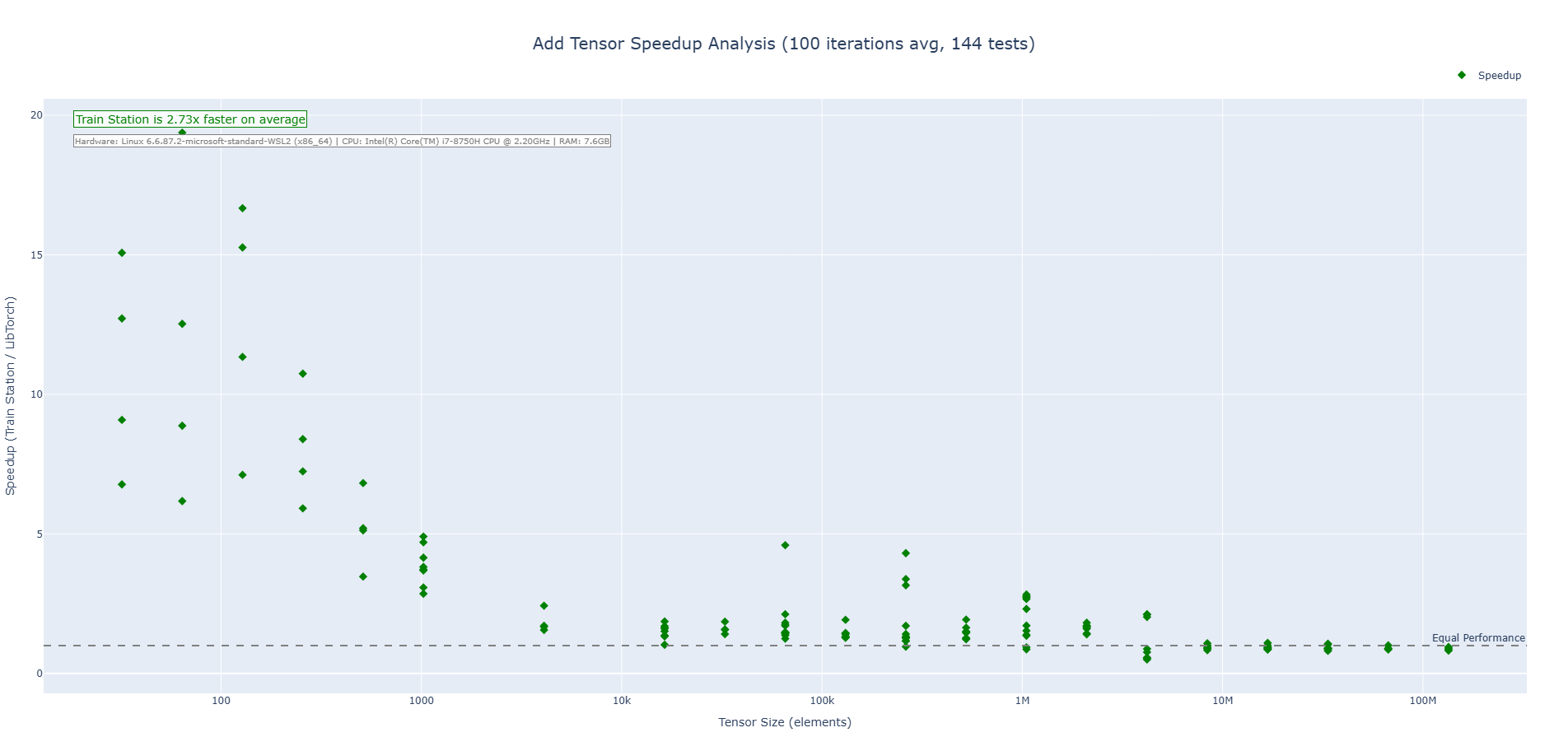
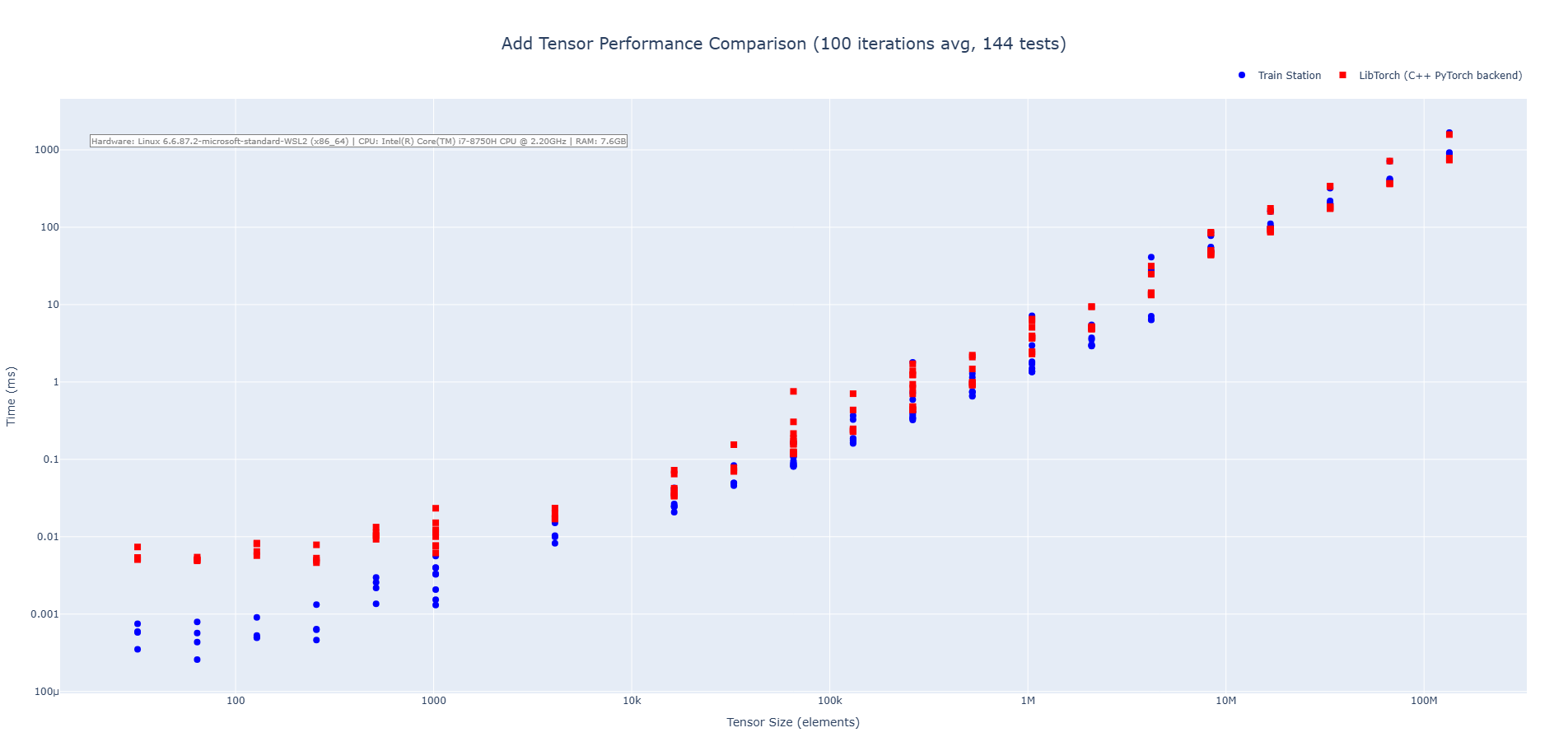
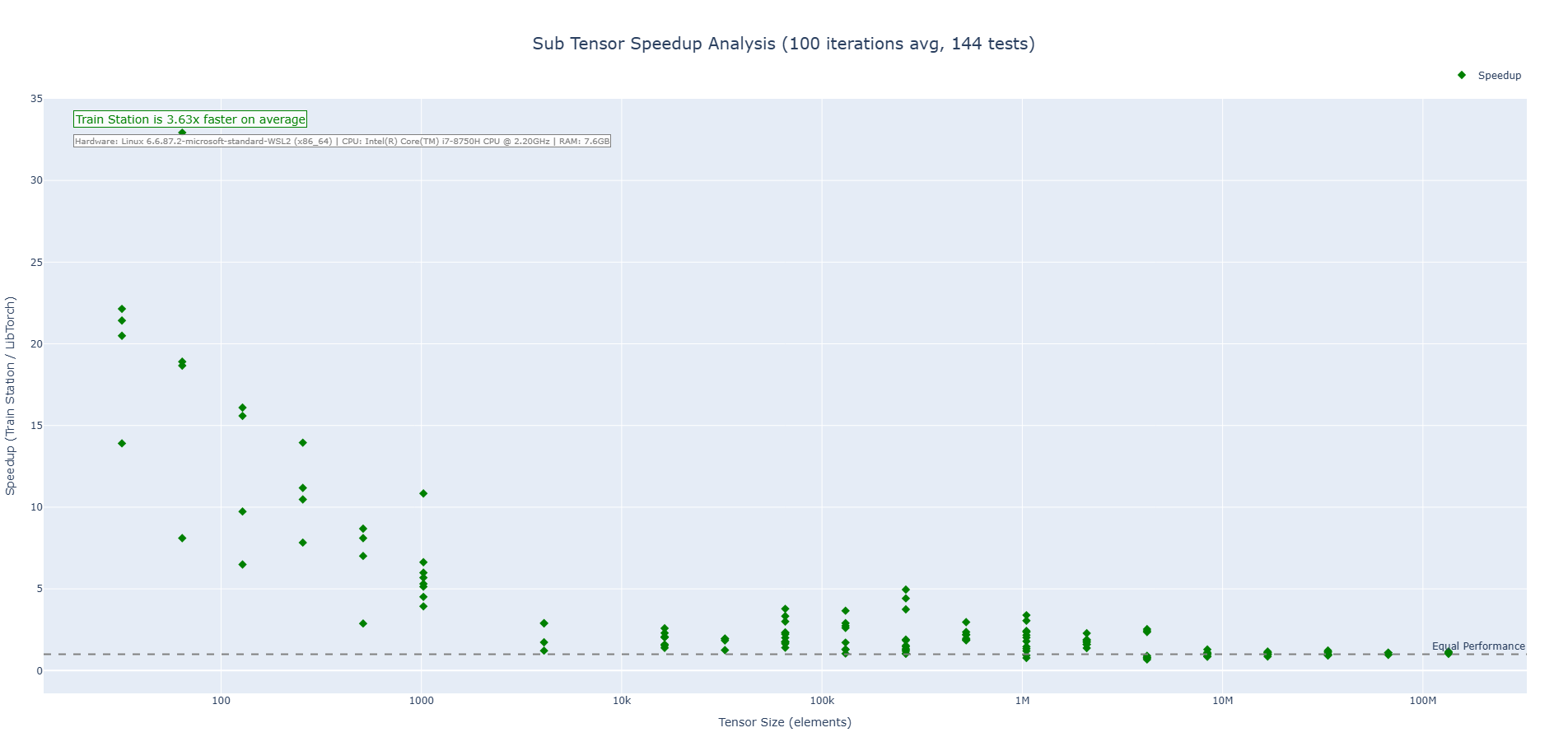
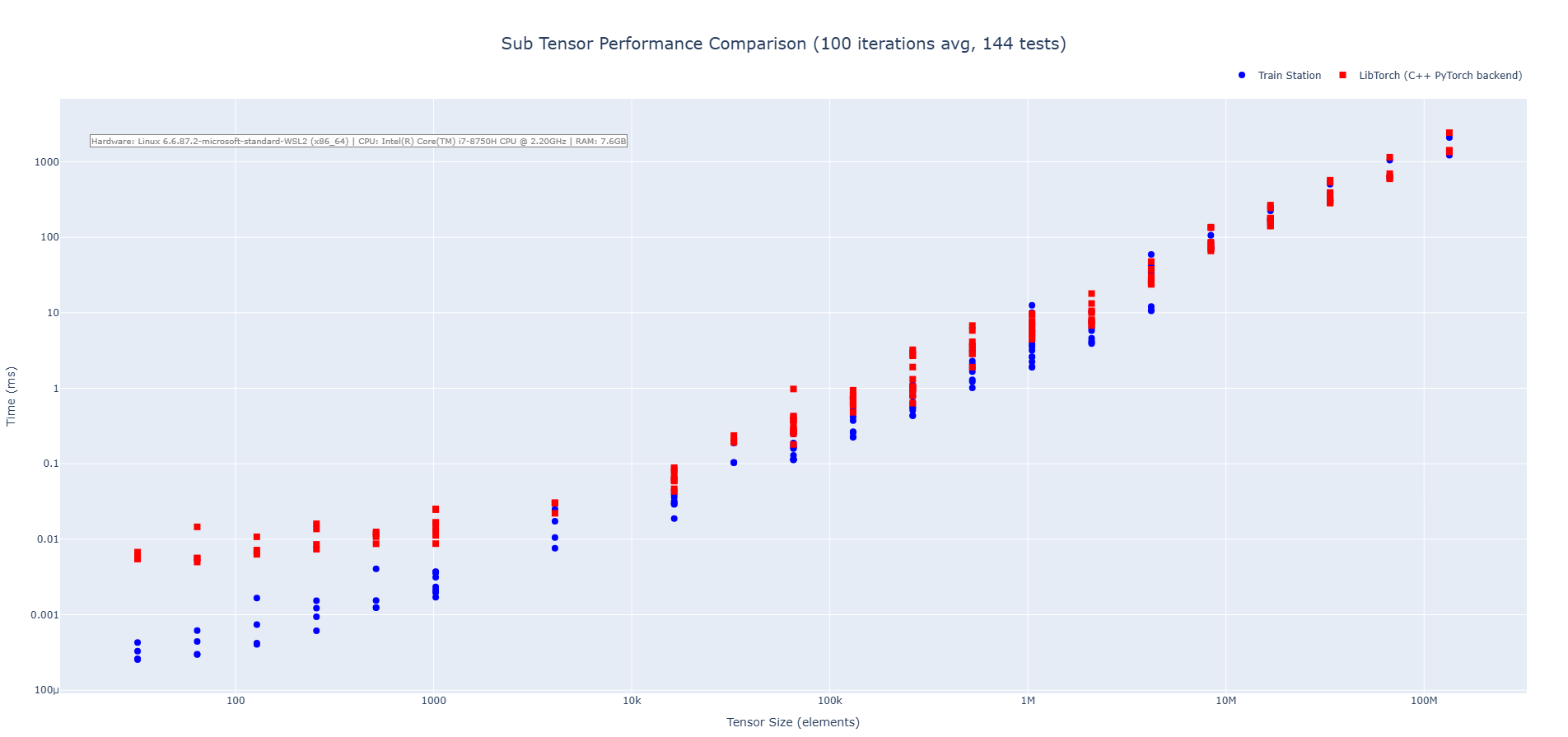
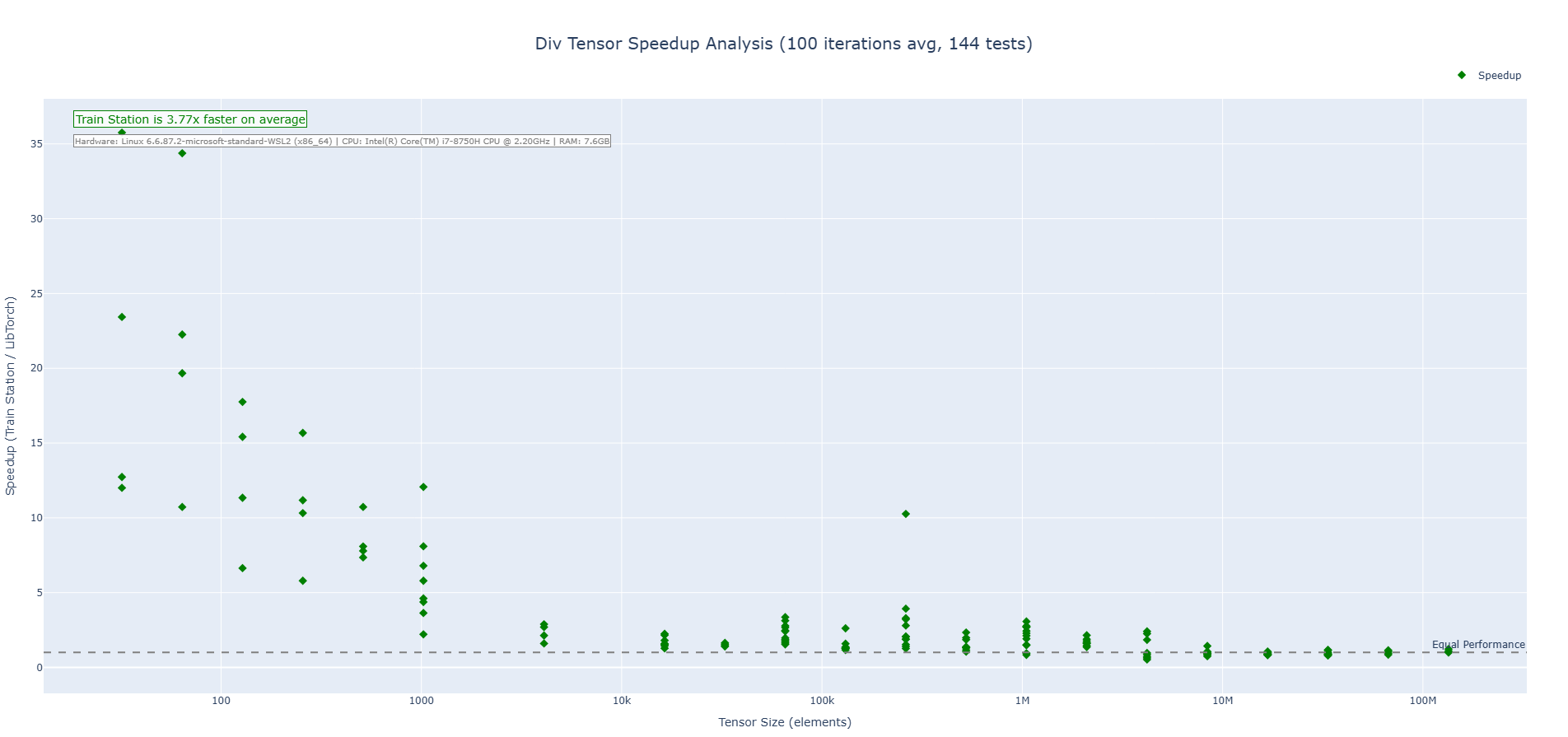
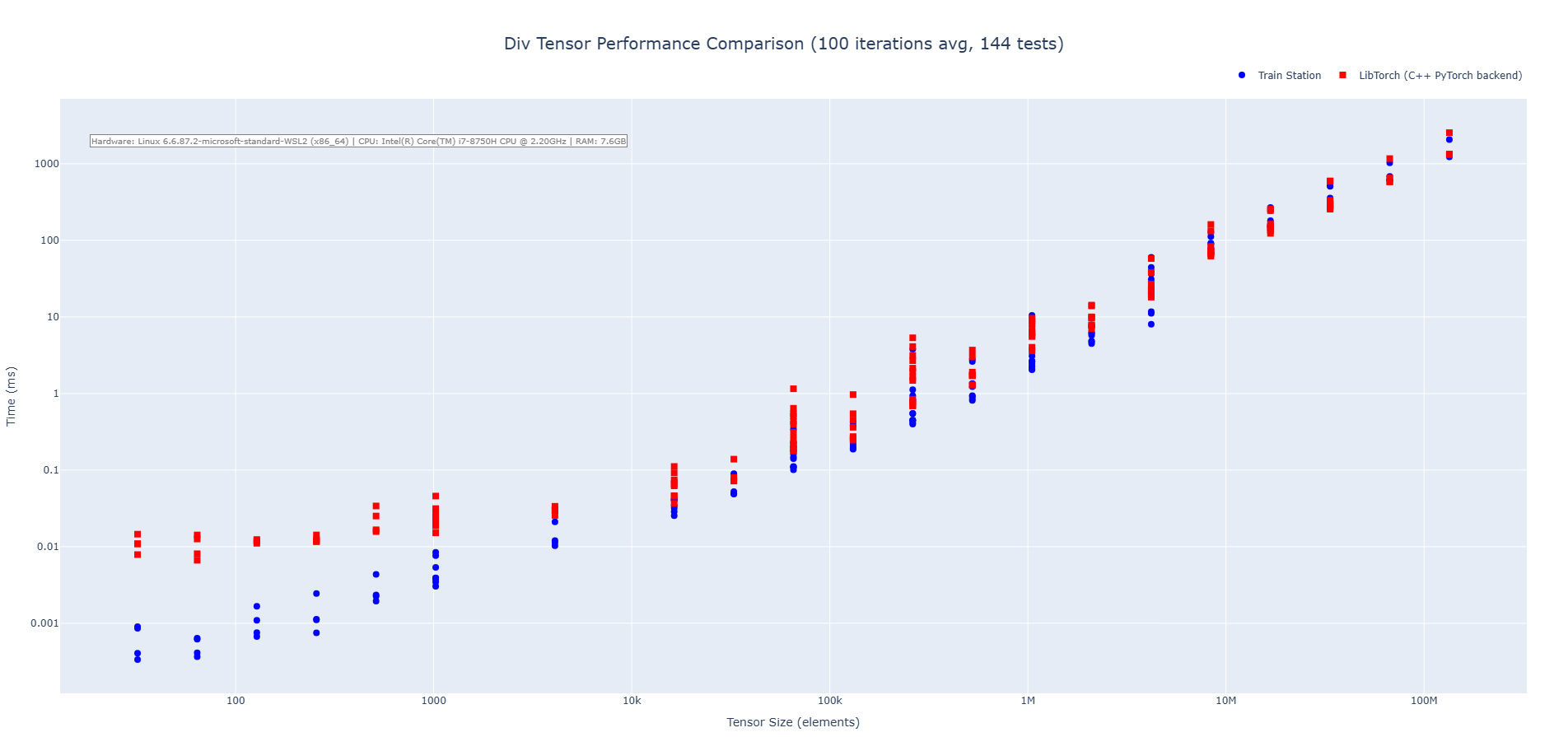
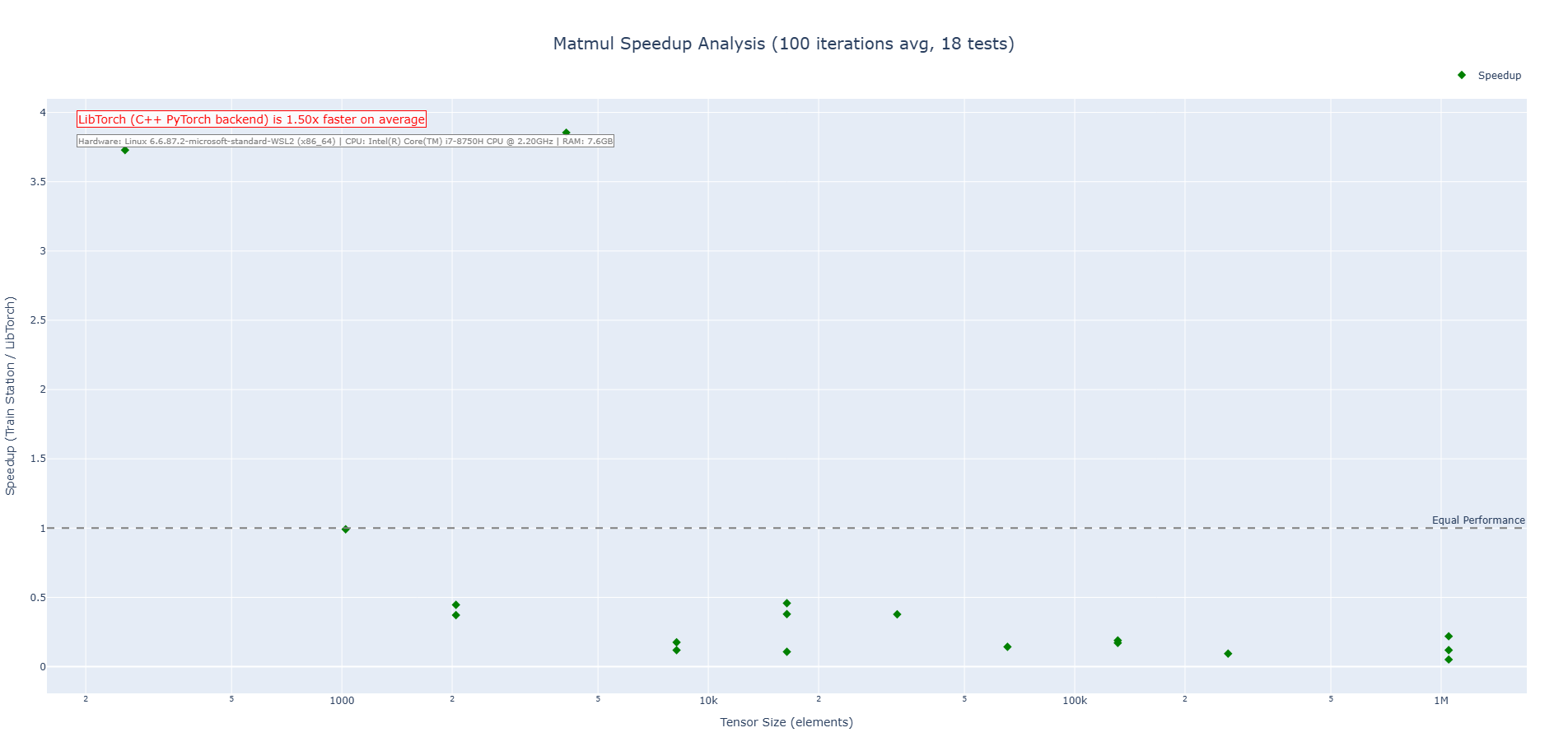
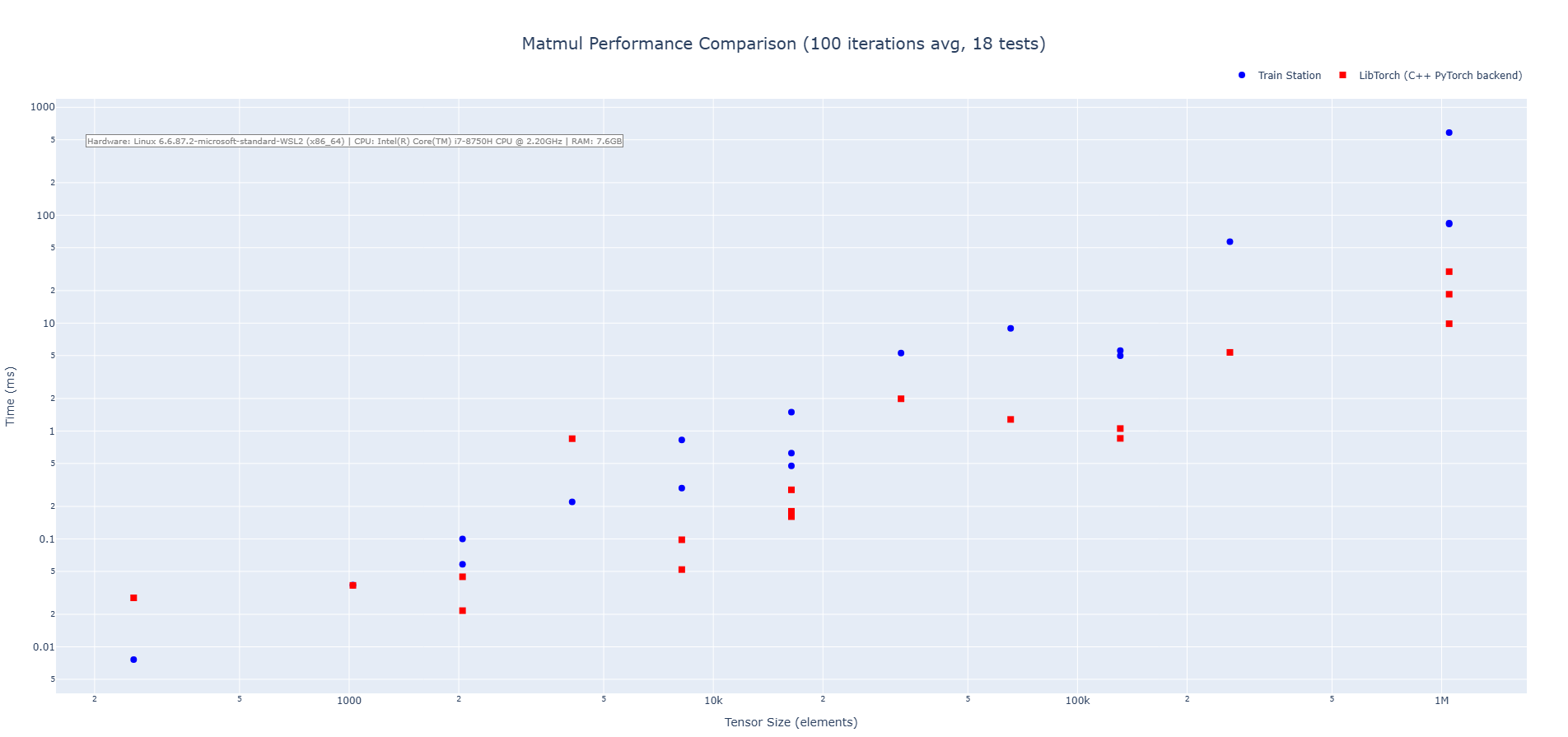
Real-world, apples-to-apples comparisons vs LibTorch (CPU):
Addition
Subtraction
Multiplication
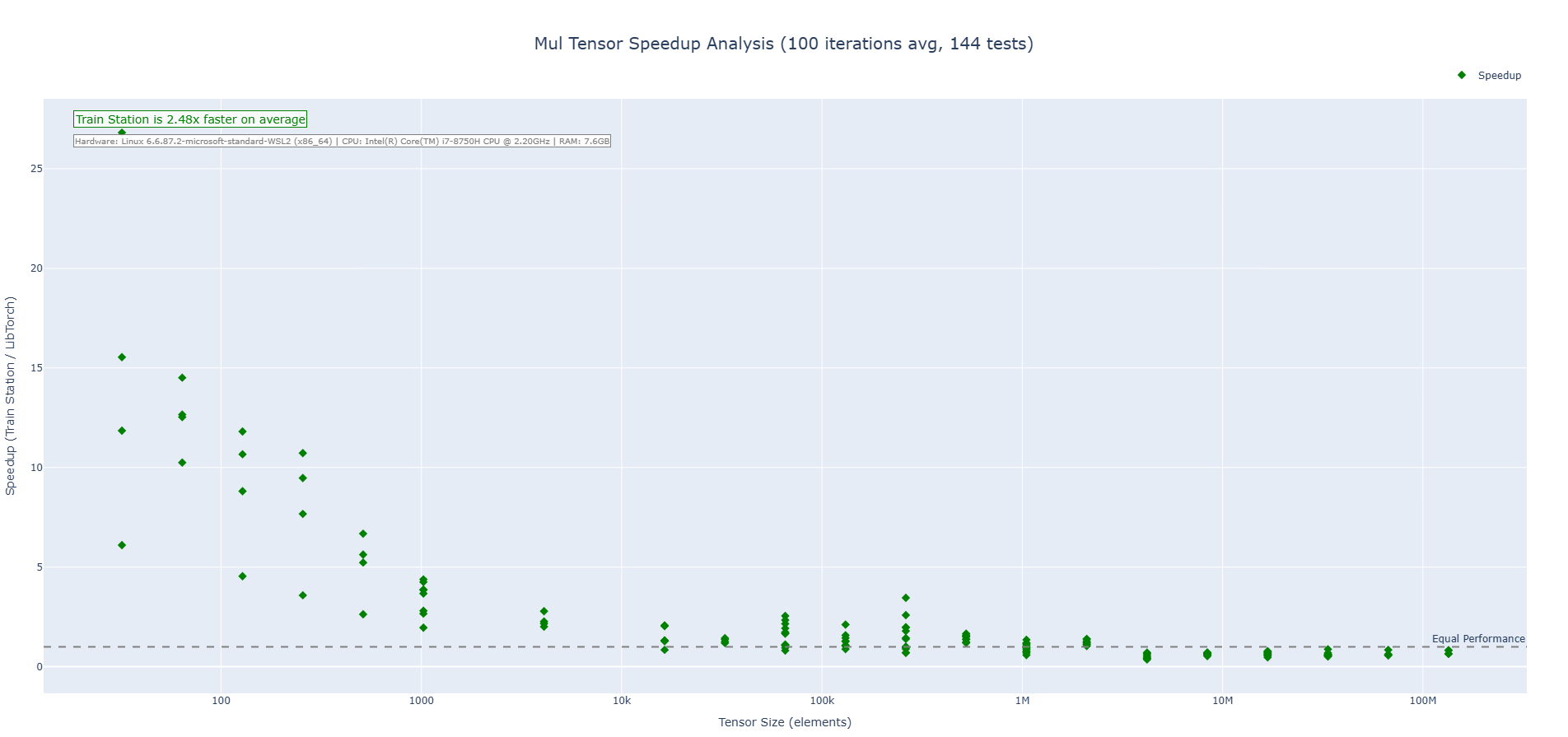
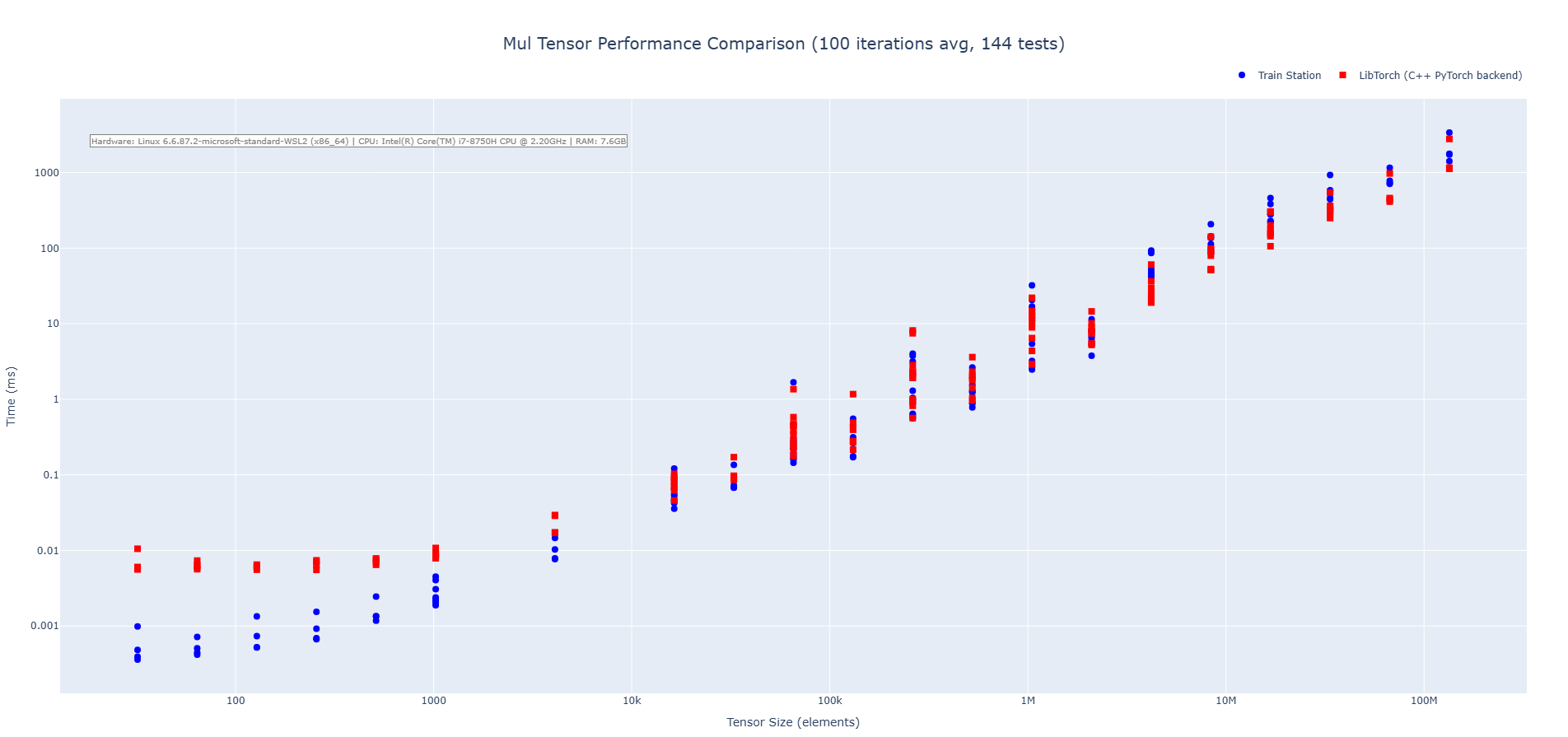
Division
Matrix Multiplication
Install & Platform Support
- Works on Linux, Windows, and macOS; x86_64 and ARM64 validated in CI.
- Add via Cargo:
[dependencies]
train-station = "0.2"
For detailed platform matrices, cross-compilation, and feature flags, see the original README.md.
Links
- Crate: https://crates.io/crates/train-station
- Docs: https://docs.rs/train-station
- CI: see badges above
- Source: https://github.com/ewhinery8/train-station
CUDA Status
- The
cudafeature is experimental and not ready for general use. It currently exposes scaffolding only; CPU is the supported path. Expect breaking changes while this area evolves.
Roadmap
- Broaden core capabilities while staying zero-dependency and performance-first.
- Expand autograd coverage and iterator/view integrations across more operations.
- Evolve dtype support beyond
f32while preserving ergonomics and speed. - Grow the operation set and numerics needed for modern and next‑gen architectures.
- Mature training infrastructure (optimizers, serialization, reproducibility).
- Advance multi-threading and device support while keeping APIs simple and safe.
— Built for speed. Validated for correctness. Iterate faster.