u64_2
| Crates.io | u64_2 |
| lib.rs | u64_2 |
| version | 0.1.3 |
| created_at | 2025-12-30 17:29:41.26027+00 |
| updated_at | 2025-12-30 17:37:20.64424+00 |
| description | Ultra-fast dual u64 variable-length encoding / 超高速双 u64 变长编码 |
| homepage | https://github.com/js0-site/rust/tree/main/u64_2 |
| repository | https://github.com/js0-site/rust.git |
| max_upload_size | |
| id | 2013066 |
| size | 104,421 |
 i18n.site (i18nsite)
documentation
README
u64_2
u64_2 is a highly customized variable-length encoding scheme specifically designed for simultaneously storing two u64 integers.
Compared to standard VByte (Varint/LEB128), this scheme eliminates branch loops in the decoding process by grouping metadata (length information), thereby maximizing the utilization of modern CPU pipelines and branch prediction capabilities (such as Apple Silicon M series). It maintains high compression ratios while providing decoding speeds close to memory copy (Memcpy) levels.
Core Advantages
- Ultra-fast Decoding: Completely branchless logic without
whileloops, decoding requires only simple bitwise operations and memory reads. - Compact Storage: Minimum 3 bytes (when both integers are less than 256), maximum 17 bytes.
- Hardware-friendly: Optimized for CPUs supporting unaligned memory access (such as ARM64/x64), can load data in one go using registers and mask clean.
Data Layout (Bit Layout)
The encoded data stream consists of a Tag (tag byte) and subsequent Data Body (data body).
Structure diagram:
[Tag (1 Byte)] [Integer A Bytes...] [Integer B Bytes...]
1. Tag Byte (Header)
Tag is the first byte of the data stream, which records the byte length information of both integers simultaneously. Tag is split into high 4 bits and low 4 bits:
- High 4 bits (Bits 7-4): Store the byte length of Integer A.
- Low 4 bits (Bits 3-0): Store the byte length of Integer B.
Length Encoding Rule (-1 offset):
To maximize space utilization, the stored length value = actual byte count - 1.
- Stored value
0(0000) $\rightarrow$ represents actual length 1 byte. - Stored value
7(0111) $\rightarrow$ represents actual length 8 bytes.
2. Data Body (Payload)
Following the Tag is the pure data part, arranged in order:
- Integer A data: Stored in little-endian order, length determined by Tag high 4 bits.
- Integer B data: Stored in little-endian order, length determined by Tag low 4 bits.
Encoding/Decoding Logic Explanation
Encoding Process
- Calculate Length: Determine the minimum byte count required for integers A and B (range 1-8) by calculating leading zeros.
- Build Tag:
- Subtract 1 from A's length, shift left by 4 bits.
- Subtract 1 from B's length.
- Perform OR operation on both to generate Tag byte.
- Write Data:
- Write Tag byte.
- Write valid bytes of integer A (little-endian) to buffer.
- Write valid bytes of integer B (little-endian).
Decoding Process - Performance Critical
Decoding is the core optimization point of this algorithm, using Masking technique to replace traditional byte-by-byte reading.
- Read Tag: Read the first byte.
- Parse Length:
- Right shift by 4 bits and add 1 to get A's length
LenA. - Mask low 4 bits and add 1 to get B's length
LenB.
- Right shift by 4 bits and add 1 to get A's length
- Fast Load:
- Load A: Using CPU's unaligned read capability, directly load a complete 64-bit word (8 bytes) from the position after Tag, then look up table based on
LenAand use mask to clear high-bit garbage data. - Load B: Calculate B's starting offset (
1 + LenA), similarly load a complete 64-bit word, look up table based onLenBand apply mask.
- Load A: Using CPU's unaligned read capability, directly load a complete 64-bit word (8 bytes) from the position after Tag, then look up table based on
- Return Result: Output two restored integers.
Performance Comparison Principle: Why faster than VByte?
Traditional VByte Pain Points
- Branch Dependency: VByte decoding needs to check the most significant bit (MSB) of each byte to decide whether to continue reading. This means decoding an 8-byte integer might require CPU to make 8 branch predictions.
- Pipeline Stall: Once branch prediction fails, the CPU pipeline will be cleared, causing serious performance penalties.
Dual-U64 Group Varint Advantages
- Deterministic Execution: After reading Tag, CPU knows exactly what to do next.
- Instruction-level Parallelism: Parsing length and loading data can be optimized by the compiler into parallel instruction sequences.
- Reduced Memory Interaction: By reading 64-bit wide words instead of single bytes, the number of memory bus interactions is reduced.
Applicable Scenarios
- Data structures containing fixed (Key, Value) pairs both as
u64. - (DocID, Frequency) blocks in inverted indexes.
- Serialization scenarios requiring extremely high throughput with only a small number of integers (2-4).
Usage
Encoding
use u64_2::encode;

let mut buffer = [0u8; 32];
let num1: u64 = 500;        // Needs 2 bytes
let num2: u64 = 100000;     // Needs 3 bytes

let len = encode(num1, num2, &mut buffer);
// Encoded data is in &buffer[..len]
Decoding
use u64_2::decode;

let encoded_data = [0x12, 0xF4, 0x01, 0xA0, 0x86, 0x01];
let (num1, num2, consumed) = decode(&encoded_data);
// num1 = 500, num2 = 100000, consumed = 6
Performance Benchmarks
For detailed performance benchmark results, please refer to benches/RESULTS.md.
Run benchmarks:
cargo bench --bench u64_encode_decode
Key performance indicators:
- Encoding time: ~4.5 ns
- Decoding time: ~5.3 ns
- Throughput: ~180M elements/s
License
This project is licensed under MulanPSL-2.0.
Bench
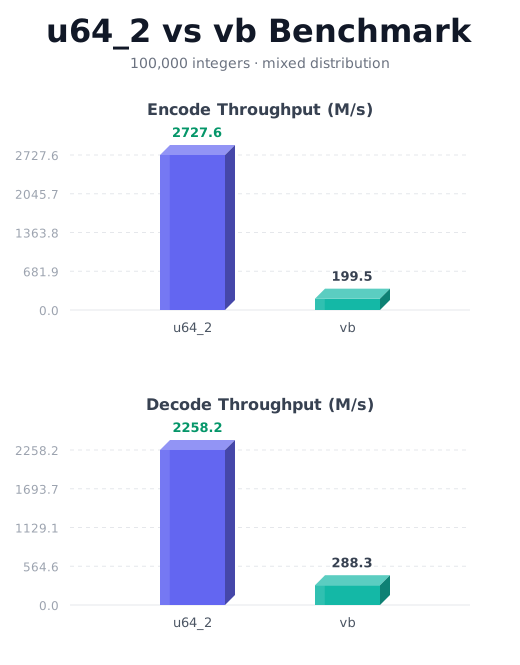
u64_2 vs vb Benchmark
Comparing u64_2 (pair encoding) with vb (varint) using 100,000 integers (mixed distribution: 60% small, 30% medium, 10% large).
Results
| Library | Encode (M/s) | Decode (M/s) |
|---|---|---|
| u64_2 | 2727.6 | 2258.2 |
| vb | 199.5 | 288.3 |
Environment
macOS 26.1 (arm64) · Apple M2 Max · 12 cores · 64.0GB · rustc 1.94.0-nightly (21ff67df1 2025-12-15)
About
This project is an open-source component of js0.site ⋅ Refactoring the Internet Plan.
We are redefining the development paradigm of the Internet in a componentized way. Welcome to follow us:
u64_2
u64_2 是一种高度定制化的变长编码方案,专为同时存储两个 u64 整数而设计。
与标准的 VByte (Varint/LEB128) 相比,本方案通过将元数据(长度信息)分组存储,彻底消除了解码过程中的分支循环(Branch Loops),从而最大限度地利用现代 CPU(如 Apple Silicon M 系列)的流水线和分支预测能力。它在保持高压缩率的同时,提供接近内存拷贝(Memcpy)级别的解码速度。
核心优势
- 极速解码:完全无分支(Branchless)逻辑,无
while循环,解码仅需简单的位运算和内存读取。 - 紧凑存储:最小仅占用 3 字节(两个整数均小于 256 时),最大占用 17 字节。
- 硬件友好:针对支持非对齐内存访问(Unaligned Access)的 CPU(如 ARM64/x64)进行了优化,可利用寄存器一次性加载数据并掩码清洗。
数据布局 (Bit Layout)
编码后的数据流由一个 Tag(标签字节) 和随后的 Data Body(数据体) 组成。
结构示意图:
[Tag (1 Byte)] [Integer A Bytes...] [Integer B Bytes...]
1. Tag 字节 (Header)
Tag 是数据流的第一个字节,它同时记录了两个整数的字节长度信息。Tag 被拆分为高 4 位和低 4 位:
- 高 4 位 (Bits 7-4):存储 整数 A 的字节长度。
- 低 4 位 (Bits 3-0):存储 整数 B 的字节长度。
长度编码规则(-1 偏移):
为了最大化利用空间,存储的长度值 = 实际字节数 - 1。
- 存储值
0(0000) $\rightarrow$ 代表实际长度 1 字节。 - 存储值
7(0111) $\rightarrow$ 代表实际长度 8 字节。
2. Data Body (Payload)
紧随 Tag 之后的是纯数据部分,按顺序排列:
- 整数 A 的数据:按小端序(Little Endian)存储,长度由 Tag 高 4 位决定。
- 整数 B 的数据:按小端序(Little Endian)存储,长度由 Tag 低 4 位决定。
编解码逻辑说明
编码流程 (Encoding)
- 计算长度:通过计算整数的前导零(Leading Zeros),确定整数 A 和整数 B 各自需要的最小字节数(范围 1-8)。
- 构建 Tag:
- 将 A 的长度减 1,左移 4 位。
- 将 B 的长度减 1。
- 将两者进行"或"运算(OR),生成 Tag 字节。
- 写入数据:
- 写入 Tag 字节。
- 将整数 A 的有效字节(小端序)写入缓冲区。
- 紧接着写入整数 B 的有效字节(小端序)。
解码流程 (Decoding) - 性能关键
解码是本算法的核心优化点,采用 Masking(掩码) 技术替代传统的字节逐个读取。
- 读取 Tag:读取第一个字节。
- 解析长度:
- 右移 4 位并加 1,得到 A 的长度
LenA。 - 低 4 位掩码并加 1,得到 B 的长度
LenB。
- 右移 4 位并加 1,得到 A 的长度
- 快速加载 (Fast Load):
- 加载 A:利用 CPU 的非对齐读取能力,直接从 Tag 之后的位置加载一个完整的 64 位字(8 字节),然后根据
LenA查表,使用掩码将高位垃圾数据清零。 - 加载 B:计算出 B 的起始偏移量(
1 + LenA),同样加载一个完整的 64 位字,根据LenB查表并应用掩码。
- 加载 A:利用 CPU 的非对齐读取能力,直接从 Tag 之后的位置加载一个完整的 64 位字(8 字节),然后根据
- 返回结果:输出两个还原的整数。
性能对比原理:为什么比 VByte 快?
传统 VByte 的痛点
- 分支依赖:VByte 解码每一个字节都需要检查最高位(MSB)来决定是否继续读取。这意味着解码一个 8 字节整数可能需要 CPU 做 8 次分支预测。
- 流水线停顿:一旦分支预测失败,CPU 流水线会被清空,导致严重的性能惩罚。
Dual-U64 Group Varint 的优势
- 确定性执行:读取 Tag 后,CPU 精确知道接下来该做什么。
- 指令级并行:解析长度和加载数据可以被编译器优化为并行的指令序列。
- 减少内存交互:通过读取 64 位宽字(Word)而非单个字节,减少了内存总线的交互次数。
适用场景
- 数据结构中含有固定的 (Key, Value) 均为
u64的 Pair 对。 - 倒排索引中的 (DocID, Frequency) 块。
- 需要极高吞吐量且只有少量整数(2-4个)的序列化场景。
使用方法
编码
use u64_2::encode;

let mut buffer = [0u8; 32];
let num1: u64 = 500;        // 需要 2 字节
let num2: u64 = 100000;     // 需要 3 字节

let len = encode(num1, num2, &mut buffer);
// 编码后的数据在 &buffer[..len] 中
解码
use u64_2::decode;

let encoded_data = [0x12, 0xF4, 0x01, 0xA0, 0x86, 0x01];
let (num1, num2, consumed) = decode(&encoded_data);
// num1 = 500, num2 = 100000, consumed = 6
性能评测
详细的性能评测结果请参考 benches/RESULTS.md。
运行评测:
cargo bench --bench u64_encode_decode
关键性能指标:
- 编码时间:~4.5 ns
- 解码时间:~5.3 ns
- 吞吐量:~180M elements/s
许可证
本项目采用 MulanPSL-2.0 许可证。
评测
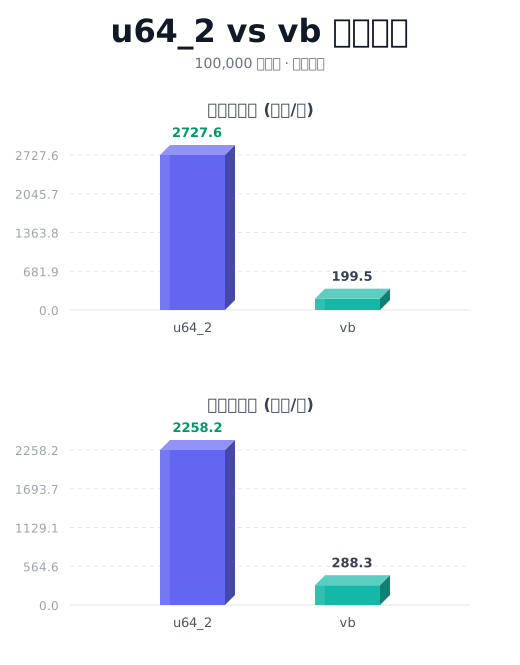
u64_2 vs vb 性能评测
对比 u64_2(双值编码)与 vb(变长编码),测试数据:100,000 个整数(混合分布:60% 小值,30% 中值,10% 大值)。
结果
| 库 | 编码 (百万/秒) | 解码 (百万/秒) |
|---|---|---|
| u64_2 | 2727.6 | 2258.2 |
| vb | 199.5 | 288.3 |
环境
macOS 26.1 (arm64) · Apple M2 Max · 12 核 · 64.0GB · rustc 1.94.0-nightly (21ff67df1 2025-12-15)
关于
本项目为 js0.site ⋅ 重构互联网计划 的开源组件。
我们正在以组件化的方式重新定义互联网的开发范式,欢迎关注: